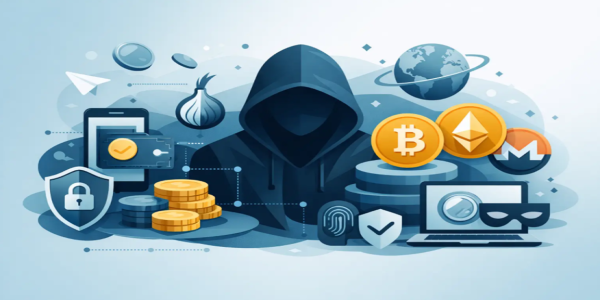
7 Best Anonymous Crypto Payment Options
Compare the best anonymous crypto payment options for private, fast transactions. See trade-offs, fees, and what works best for real use.
Privacy gets marketed like a switch you can flip. It is not. If you are searching for the best anonymous crypto payment options, what you really need is a clear view of which methods reduce your exposure, where they fall short, and how fast you can actually move when it matters.
For traders and everyday crypto users, the right choice depends on one thing above all - what kind of privacy you need. Some payment options hide your identity from the public blockchain. Others reduce what platforms collect about you. A few do both reasonably well. None are magic. The smartest move is picking the option that matches your risk tolerance, speed needs, and preferred level of control.
What makes a crypto payment option truly anonymous?
Most people use the word anonymous when they really mean private or pseudonymous. That distinction matters.
Bitcoin, for example, is not anonymous in the strict sense. Wallet addresses do not show your name, but transaction history is public and traceable. If an address gets tied to your identity through an exchange, merchant, or reused wallet, the privacy gap opens fast. The same goes for many popular coins and payment rails.
A better way to judge anonymous crypto payment options is by asking three questions. First, how much personal information does the platform collect? Second, how visible is your transaction history on-chain? Third, how easy is it to separate one payment from your broader activity? The stronger the answer across all three, the better the privacy outcome.
The best anonymous crypto payment options right now
1. Monero for direct wallet-to-wallet payments
If your priority is transaction privacy first, Monero remains one of the strongest options available. It was built for confidentiality, not retrofitted for it later. Sender details, receiver details, and transaction amounts are obscured by design.
That makes Monero a standout for users who want private peer-to-peer transfers without broadcasting a transparent financial history. It is especially useful when you want to avoid the common blockchain trail found on more visible networks.
The trade-off is adoption. Fewer merchants accept Monero directly, and some exchanges have limited access to it. So while it ranks high among the best anonymous crypto payment options, it may not always be the easiest to spend everywhere.
2. Bitcoin through peer-to-peer transactions
Bitcoin is not private by default, but it still plays a role when used carefully in peer-to-peer settings. Its biggest advantage is reach. Almost everyone in crypto knows how to send it, receive it, and price goods in it.
For privacy-conscious users, the appeal comes from flexibility rather than built-in anonymity. If you use fresh addresses, avoid identity-heavy platforms, and transact directly with counterparties you trust, you can reduce exposure compared with mainstream exchange-based activity.
The downside is obvious. Bitcoin's ledger is public forever. That means mistakes travel with you. If privacy is your top priority, Bitcoin is workable but not ideal.
3. Litecoin for fast, lower-cost private transfers
Litecoin sits in a practical middle lane. It is faster and often cheaper to send than Bitcoin, which helps for small payments and quick settlements. For users who value speed and broad compatibility, that matters.
It is not an anonymous coin in the same category as Monero, but it can be a useful payment option for users who want a lower-friction crypto transaction without paying high network fees. In real use, that makes it attractive for frequent transfers where cost discipline matters.
Its limitation is the same as many transparent chains. Good operational privacy still depends on user behavior, not just the network.
4. Privacy-focused peer-to-peer exchange payments
Sometimes the payment option is not just the coin. It is the path you use to get it, swap it, and move it. Privacy-focused peer-to-peer exchange environments can reduce friction and cut back on the personal data demanded by conventional platforms.
That is where users often find real leverage. If a platform supports flexible funding, fast conversions, wallet functionality, and low-barrier access to a wide range of digital assets, it becomes much easier to structure payments on your own terms. Budrigan Market fits this appeal for users who want speed, broad crypto access, and fewer onboarding obstacles before they start moving funds.
The trade-off is that peer-to-peer environments require more personal responsibility. You need to understand pricing, timing, counterparties, and how your chosen asset behaves once it leaves the platform.
5. Stablecoins for discreet value transfer
Stablecoins are not usually the first thing people mention in conversations about anonymous crypto payment options, but they deserve a spot. If you need predictable value, a stablecoin can make private payment planning easier because you are not dealing with sudden price swings between sending and receiving.
That can be useful for cross-border transactions, freelance payments, or temporary holdings before a conversion. A stablecoin also helps users who want to avoid the volatility of major crypto assets while still operating outside traditional payment rails.
Still, privacy depends heavily on the network and wallet practices involved. A stablecoin on a transparent blockchain is only as private as your transaction habits allow.
6. Prepaid crypto cards funded indirectly
For users who want to spend crypto in the real world without directly exposing a wallet at every purchase, prepaid card structures can offer some separation. The idea is simple: convert crypto, load value, and spend through a card layer instead of making on-chain payments for each transaction.
This can be practical for day-to-day use, but it is not strong anonymity. Card providers often collect user data, and the convenience usually comes with more centralization. So this option works better for spending flexibility than for deep privacy.
If your goal is pure anonymity, this is not the front-runner. If your goal is using crypto with less friction at checkout, it has a place.
7. Gift card conversions and voucher-style spending
This is one of the more overlooked options. Converting crypto into merchant gift cards or digital vouchers can create a useful payment buffer between your wallet and your purchase. For some users, that extra layer is enough to feel more comfortable.
It is also simple. You are not asking every merchant to accept crypto directly. You are using crypto to buy access to a retail payment instrument.
But again, there is a trade-off. Privacy varies by provider, and fees can quietly stack up. It is convenient, not perfect.
How to choose among the best anonymous crypto payment options
Start with your use case, not the hype. If you want the strongest on-chain privacy, a privacy coin is usually the better fit. If you need broad acceptance, major coins are easier to use but weaker on confidentiality. If you need stable value, stablecoins can be the practical answer even if they are not the most private by design.
You should also think about speed. Some users care most about getting in and out of a position quickly. Others care more about minimizing records tied to a payment trail. Those goals can point to different tools.
Then there is the platform question. A payment method does not exist in a vacuum. The way you acquire, convert, store, and send funds shapes your privacy just as much as the asset itself. Fast access, fewer onboarding barriers, and broad crypto availability can make a real difference if you want more control from the start.
The trade-offs most articles skip
There is no perfect anonymous payment stack. More privacy can mean less merchant support. More convenience can mean more data collection. Lower fees can come with weaker confidentiality. Anyone telling you otherwise is selling fantasy.
There is also a legal and practical reality to consider. Privacy tools can protect legitimate financial autonomy, but users still need to understand the rules in their own jurisdiction and use these options responsibly. Smart privacy is about control, not carelessness.
For many users, the best path is layered. Use a platform that gives you fast, flexible access. Choose an asset that matches your privacy goals. Avoid reusing addresses. Keep your wallet habits clean. Small decisions add up.
A smarter way to think about anonymous crypto payments
The best anonymous crypto payment options are not always the most famous names. They are the ones that fit how you actually move money. For one user, that is Monero and direct wallet transfers. For another, it is a fast peer-to-peer conversion into the right asset at the right moment. For someone else, it is a stablecoin used with discipline and purpose.
What matters is freedom with clarity. Pick the option that gives you enough privacy for your real use case, enough speed to stay flexible, and enough control to act without waiting on gatekeepers. When your payment tools work on your terms, the market opens up fast.
Share This Post
Compare the best anonymous crypto payment options for private, fast transactions. See trade-offs, fees, and what works best for real use.
Privacy gets marketed like a switch you can flip. It is not. If you are searching for the best anonymous crypto payment options, what you really need is a clear view of which methods reduce your exposure, where they fall short, and how fast you can actually move when it matters.
For traders and everyday crypto users, the right choice depends on one thing above all - what kind of privacy you need. Some payment options hide your identity from the public blockchain. Others reduce what platforms collect about you. A few do both reasonably well. None are magic. The smartest move is picking the option that matches your risk tolerance, speed needs, and preferred level of control.
What makes a crypto payment option truly anonymous?
Most people use the word anonymous when they really mean private or pseudonymous. That distinction matters.
Bitcoin, for example, is not anonymous in the strict sense. Wallet addresses do not show your name, but transaction history is public and traceable. If an address gets tied to your identity through an exchange, merchant, or reused wallet, the privacy gap opens fast. The same goes for many popular coins and payment rails.
A better way to judge anonymous crypto payment options is by asking three questions. First, how much personal information does the platform collect? Second, how visible is your transaction history on-chain? Third, how easy is it to separate one payment from your broader activity? The stronger the answer across all three, the better the privacy outcome.
The best anonymous crypto payment options right now
1. Monero for direct wallet-to-wallet payments
If your priority is transaction privacy first, Monero remains one of the strongest options available. It was built for confidentiality, not retrofitted for it later. Sender details, receiver details, and transaction amounts are obscured by design.
That makes Monero a standout for users who want private peer-to-peer transfers without broadcasting a transparent financial history. It is especially useful when you want to avoid the common blockchain trail found on more visible networks.
The trade-off is adoption. Fewer merchants accept Monero directly, and some exchanges have limited access to it. So while it ranks high among the best anonymous crypto payment options, it may not always be the easiest to spend everywhere.
2. Bitcoin through peer-to-peer transactions
Bitcoin is not private by default, but it still plays a role when used carefully in peer-to-peer settings. Its biggest advantage is reach. Almost everyone in crypto knows how to send it, receive it, and price goods in it.
For privacy-conscious users, the appeal comes from flexibility rather than built-in anonymity. If you use fresh addresses, avoid identity-heavy platforms, and transact directly with counterparties you trust, you can reduce exposure compared with mainstream exchange-based activity.
The downside is obvious. Bitcoin's ledger is public forever. That means mistakes travel with you. If privacy is your top priority, Bitcoin is workable but not ideal.
3. Litecoin for fast, lower-cost private transfers
Litecoin sits in a practical middle lane. It is faster and often cheaper to send than Bitcoin, which helps for small payments and quick settlements. For users who value speed and broad compatibility, that matters.
It is not an anonymous coin in the same category as Monero, but it can be a useful payment option for users who want a lower-friction crypto transaction without paying high network fees. In real use, that makes it attractive for frequent transfers where cost discipline matters.
Its limitation is the same as many transparent chains. Good operational privacy still depends on user behavior, not just the network.
4. Privacy-focused peer-to-peer exchange payments
Sometimes the payment option is not just the coin. It is the path you use to get it, swap it, and move it. Privacy-focused peer-to-peer exchange environments can reduce friction and cut back on the personal data demanded by conventional platforms.
That is where users often find real leverage. If a platform supports flexible funding, fast conversions, wallet functionality, and low-barrier access to a wide range of digital assets, it becomes much easier to structure payments on your own terms. Budrigan Market fits this appeal for users who want speed, broad crypto access, and fewer onboarding obstacles before they start moving funds.
The trade-off is that peer-to-peer environments require more personal responsibility. You need to understand pricing, timing, counterparties, and how your chosen asset behaves once it leaves the platform.
5. Stablecoins for discreet value transfer
Stablecoins are not usually the first thing people mention in conversations about anonymous crypto payment options, but they deserve a spot. If you need predictable value, a stablecoin can make private payment planning easier because you are not dealing with sudden price swings between sending and receiving.
That can be useful for cross-border transactions, freelance payments, or temporary holdings before a conversion. A stablecoin also helps users who want to avoid the volatility of major crypto assets while still operating outside traditional payment rails.
Still, privacy depends heavily on the network and wallet practices involved. A stablecoin on a transparent blockchain is only as private as your transaction habits allow.
6. Prepaid crypto cards funded indirectly
For users who want to spend crypto in the real world without directly exposing a wallet at every purchase, prepaid card structures can offer some separation. The idea is simple: convert crypto, load value, and spend through a card layer instead of making on-chain payments for each transaction.
This can be practical for day-to-day use, but it is not strong anonymity. Card providers often collect user data, and the convenience usually comes with more centralization. So this option works better for spending flexibility than for deep privacy.
If your goal is pure anonymity, this is not the front-runner. If your goal is using crypto with less friction at checkout, it has a place.
7. Gift card conversions and voucher-style spending
This is one of the more overlooked options. Converting crypto into merchant gift cards or digital vouchers can create a useful payment buffer between your wallet and your purchase. For some users, that extra layer is enough to feel more comfortable.
It is also simple. You are not asking every merchant to accept crypto directly. You are using crypto to buy access to a retail payment instrument.
But again, there is a trade-off. Privacy varies by provider, and fees can quietly stack up. It is convenient, not perfect.
How to choose among the best anonymous crypto payment options
Start with your use case, not the hype. If you want the strongest on-chain privacy, a privacy coin is usually the better fit. If you need broad acceptance, major coins are easier to use but weaker on confidentiality. If you need stable value, stablecoins can be the practical answer even if they are not the most private by design.
You should also think about speed. Some users care most about getting in and out of a position quickly. Others care more about minimizing records tied to a payment trail. Those goals can point to different tools.
Then there is the platform question. A payment method does not exist in a vacuum. The way you acquire, convert, store, and send funds shapes your privacy just as much as the asset itself. Fast access, fewer onboarding barriers, and broad crypto availability can make a real difference if you want more control from the start.
The trade-offs most articles skip
There is no perfect anonymous payment stack. More privacy can mean less merchant support. More convenience can mean more data collection. Lower fees can come with weaker confidentiality. Anyone telling you otherwise is selling fantasy.
There is also a legal and practical reality to consider. Privacy tools can protect legitimate financial autonomy, but users still need to understand the rules in their own jurisdiction and use these options responsibly. Smart privacy is about control, not carelessness.
For many users, the best path is layered. Use a platform that gives you fast, flexible access. Choose an asset that matches your privacy goals. Avoid reusing addresses. Keep your wallet habits clean. Small decisions add up.
A smarter way to think about anonymous crypto payments
The best anonymous crypto payment options are not always the most famous names. They are the ones that fit how you actually move money. For one user, that is Monero and direct wallet transfers. For another, it is a fast peer-to-peer conversion into the right asset at the right moment. For someone else, it is a stablecoin used with discipline and purpose.
What matters is freedom with clarity. Pick the option that gives you enough privacy for your real use case, enough speed to stay flexible, and enough control to act without waiting on gatekeepers. When your payment tools work on your terms, the market opens up fast.