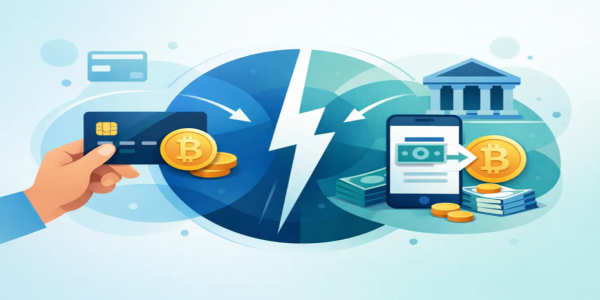
Card Purchase Versus Bank Transfer Crypto
Card purchase versus bank transfer crypto: compare speed, fees, privacy, limits, and flexibility so you can fund trades the smarter way.
You spot a market move, you want in now, and the funding method suddenly matters as much as the trade itself. That is the real question behind card purchase versus bank transfer crypto. Both get fiat into crypto, but they serve different goals, different timelines, and different types of traders.
If your priority is speed, card purchases usually win. If your priority is cost efficiency on larger amounts, bank transfers often come out ahead. But that quick answer misses the part that matters most to active traders: the best option depends on whether you care more about instant execution, lower fees, privacy, flexibility, or funding size.
Card purchase versus bank transfer crypto: what actually changes?
At a basic level, both methods do the same thing. They move your money from the traditional banking system into a crypto platform so you can buy digital assets. The difference is how fast that happens, how much it costs, how likely it is to trigger friction, and how much control you keep over the process.
A card purchase is built for immediacy. You enter your card details, confirm the amount, and in many cases your crypto purchase starts processing right away. That speed is the reason many new users prefer cards. It feels familiar, fast, and close to the way people already buy almost everything else online.
A bank transfer works more like a deliberate funding route. You send money from your bank account to the platform, wait for the transfer to settle, and then use the credited balance to buy crypto. It is less instant, but it often makes more sense when you are moving more capital or trying to reduce purchase costs.
For traders who hate waiting, that gap can feel huge. A market setup can vanish in minutes. If you are trying to react to price movement, card funding gives you a better shot at entering when you want, not hours or days later.
Speed is the biggest reason people choose cards
When people compare crypto funding methods, speed usually decides it. Card purchases are often the easiest path when you want access now. If you are buying a dip, rotating into a fast-moving altcoin, or taking advantage of an arbitrage window, instant or near-instant funding matters.
That does not mean cards are perfect. Card issuers can decline crypto-related transactions. Some banks treat exchange purchases as high-risk activity. Even when the platform is ready to process the payment, your bank may slow things down. So while cards are faster in theory and often in practice, they are not immune to outside restrictions.
Bank transfers are slower by nature. Depending on the payment rail, settlement may happen the same day or take several business days. That delay can be frustrating, especially in volatile markets. If your strategy depends on timing, a transfer can leave you watching the move happen without you.
Still, slower does not always mean worse. Some traders are not trying to catch a five-minute move. They are averaging into a position, funding larger allocations, or planning entries in stages. For them, bank transfer timing may be completely acceptable.
Fees can change the math fast
The most obvious trade-off in card purchase versus bank transfer crypto is cost. Card purchases usually carry higher processing fees. That is partly because card networks, payment processors, and risk controls all take a cut. The convenience premium is real.
For a small purchase, that premium may not matter much. If you are funding a quick $100 or $250 buy, paying more for speed can be a rational decision. You are paying for access, not just for the transaction itself.
For bigger amounts, the equation changes. A few extra percentage points on a larger purchase can become expensive fast. This is where bank transfers often make more sense. They are commonly cheaper, especially for users who plan to move more money and trade with size.
There is also a hidden cost people forget: market movement. A cheaper bank transfer is not always cheaper if the asset runs before your funds arrive. On the other hand, a higher-fee card purchase may save money if it gets you into the market before the price moves against you. That is why the smarter comparison is not just payment fee versus payment fee. It is fee versus opportunity cost.
Privacy and control matter more than most platforms admit
Many mainstream financial platforms frame funding as a simple payment question. It is not that simple for crypto users who value autonomy. The path you choose affects how exposed the transaction is to banking scrutiny, payment restrictions, and reversal risk.
Card payments are convenient, but they are also tightly monitored within traditional payment networks. Transactions can be flagged, declined, or reviewed. In some cases, users face extra friction simply because a card provider does not like the destination or category of purchase.
Bank transfers can feel more direct, but they are still connected to the banking system and its oversight. The difference is that transfers are often better suited for intentional funding behavior rather than impulse buys. For some users, that structure feels more stable. For others, it feels like one more checkpoint between them and the market.
If your goal is maximum freedom, the real issue is not whether card or transfer is universally better. It is whether the platform gives you enough flexibility to choose the route that fits your priorities. That flexibility is where opportunity starts.
Card purchase versus bank transfer crypto for beginners
Beginners usually lean toward cards first, and that makes sense. Cards are familiar. The process feels simple. You decide how much you want to buy, confirm the payment, and move on. For someone entering crypto for the first time, removing complexity is a major advantage.
The danger is that ease can hide cost. New users often focus on convenience and ignore fees, limits, or approval issues until after they hit them. If you are just starting, card purchases are often the smoothest entry point, but you should still pay attention to how much of your capital actually ends up in the asset.
Bank transfers can be better for beginners who want a more measured approach. If you are planning to buy steadily over time, or you want to fund a balance once and trade from it, a transfer may give you more breathing room. It slows the process, but sometimes slower means fewer mistakes.
For active traders, flexibility beats loyalty to one method
A lot of traders make the mistake of choosing one funding method and treating it like a permanent rule. Markets do not reward that kind of rigidity. Smart traders use the method that matches the moment.
If a setup is time-sensitive, card funding can be the right move. If you are preparing capital for a broader strategy, bank transfer can be more efficient. If fees are low enough and speed is critical, cards make sense. If size matters more than immediacy, transfers usually deserve a closer look.
This is especially true if you trade across multiple assets or react to short-lived opportunities. The funding method is not just an admin step. It is part of your execution. Delayed capital is limited capital.
That is why platforms built for freedom matter. A rigid system that forces one path creates friction before the trade even starts. A platform that supports fast access, payment flexibility, and lower barriers gives you more room to act when the market opens a door. That is part of the appeal behind Budrigan Market's approach to faster, lower-friction crypto access.
Which option is better for larger amounts?
For larger purchases, bank transfers usually have the edge. They often support higher limits and lower relative costs, which makes them more practical for users moving meaningful capital. If you are funding a serious position, card limits can become restrictive even before fees become the bigger problem.
That said, not every trader moving larger amounts wants to wait. Some will accept higher costs for immediate entry, especially during strong momentum or major news events. Again, it depends on the value of timing. In crypto, timing is not a side issue. It is often the whole trade.
There is also a behavioral factor here. Bank transfers can impose discipline. Because they are less instant, they may reduce emotional buys. Card purchases make action easier, which can be good when conviction is high and bad when the decision is impulsive.
The smarter choice depends on what you are solving for
If you want the fastest path from decision to execution, card purchases are usually the better fit. If you want to reduce fees and fund larger amounts more efficiently, bank transfers often make more sense. If you care about flexibility, the best answer is having access to both so you can choose based on the trade in front of you.
That is the real takeaway from card purchase versus bank transfer crypto. This is not a battle with one winner. It is a strategy decision. The right funding method is the one that protects your opportunity, fits your budget, and keeps unnecessary friction out of your way.
Crypto moves fast. Your funding path should support your goals, not slow them down. Choose the route that gives you control, and let that control work in your favor the next time the market gives you an opening.
Share This Post
Card purchase versus bank transfer crypto: compare speed, fees, privacy, limits, and flexibility so you can fund trades the smarter way.
You spot a market move, you want in now, and the funding method suddenly matters as much as the trade itself. That is the real question behind card purchase versus bank transfer crypto. Both get fiat into crypto, but they serve different goals, different timelines, and different types of traders.
If your priority is speed, card purchases usually win. If your priority is cost efficiency on larger amounts, bank transfers often come out ahead. But that quick answer misses the part that matters most to active traders: the best option depends on whether you care more about instant execution, lower fees, privacy, flexibility, or funding size.
Card purchase versus bank transfer crypto: what actually changes?
At a basic level, both methods do the same thing. They move your money from the traditional banking system into a crypto platform so you can buy digital assets. The difference is how fast that happens, how much it costs, how likely it is to trigger friction, and how much control you keep over the process.
A card purchase is built for immediacy. You enter your card details, confirm the amount, and in many cases your crypto purchase starts processing right away. That speed is the reason many new users prefer cards. It feels familiar, fast, and close to the way people already buy almost everything else online.
A bank transfer works more like a deliberate funding route. You send money from your bank account to the platform, wait for the transfer to settle, and then use the credited balance to buy crypto. It is less instant, but it often makes more sense when you are moving more capital or trying to reduce purchase costs.
For traders who hate waiting, that gap can feel huge. A market setup can vanish in minutes. If you are trying to react to price movement, card funding gives you a better shot at entering when you want, not hours or days later.
Speed is the biggest reason people choose cards
When people compare crypto funding methods, speed usually decides it. Card purchases are often the easiest path when you want access now. If you are buying a dip, rotating into a fast-moving altcoin, or taking advantage of an arbitrage window, instant or near-instant funding matters.
That does not mean cards are perfect. Card issuers can decline crypto-related transactions. Some banks treat exchange purchases as high-risk activity. Even when the platform is ready to process the payment, your bank may slow things down. So while cards are faster in theory and often in practice, they are not immune to outside restrictions.
Bank transfers are slower by nature. Depending on the payment rail, settlement may happen the same day or take several business days. That delay can be frustrating, especially in volatile markets. If your strategy depends on timing, a transfer can leave you watching the move happen without you.
Still, slower does not always mean worse. Some traders are not trying to catch a five-minute move. They are averaging into a position, funding larger allocations, or planning entries in stages. For them, bank transfer timing may be completely acceptable.
Fees can change the math fast
The most obvious trade-off in card purchase versus bank transfer crypto is cost. Card purchases usually carry higher processing fees. That is partly because card networks, payment processors, and risk controls all take a cut. The convenience premium is real.
For a small purchase, that premium may not matter much. If you are funding a quick $100 or $250 buy, paying more for speed can be a rational decision. You are paying for access, not just for the transaction itself.
For bigger amounts, the equation changes. A few extra percentage points on a larger purchase can become expensive fast. This is where bank transfers often make more sense. They are commonly cheaper, especially for users who plan to move more money and trade with size.
There is also a hidden cost people forget: market movement. A cheaper bank transfer is not always cheaper if the asset runs before your funds arrive. On the other hand, a higher-fee card purchase may save money if it gets you into the market before the price moves against you. That is why the smarter comparison is not just payment fee versus payment fee. It is fee versus opportunity cost.
Privacy and control matter more than most platforms admit
Many mainstream financial platforms frame funding as a simple payment question. It is not that simple for crypto users who value autonomy. The path you choose affects how exposed the transaction is to banking scrutiny, payment restrictions, and reversal risk.
Card payments are convenient, but they are also tightly monitored within traditional payment networks. Transactions can be flagged, declined, or reviewed. In some cases, users face extra friction simply because a card provider does not like the destination or category of purchase.
Bank transfers can feel more direct, but they are still connected to the banking system and its oversight. The difference is that transfers are often better suited for intentional funding behavior rather than impulse buys. For some users, that structure feels more stable. For others, it feels like one more checkpoint between them and the market.
If your goal is maximum freedom, the real issue is not whether card or transfer is universally better. It is whether the platform gives you enough flexibility to choose the route that fits your priorities. That flexibility is where opportunity starts.
Card purchase versus bank transfer crypto for beginners
Beginners usually lean toward cards first, and that makes sense. Cards are familiar. The process feels simple. You decide how much you want to buy, confirm the payment, and move on. For someone entering crypto for the first time, removing complexity is a major advantage.
The danger is that ease can hide cost. New users often focus on convenience and ignore fees, limits, or approval issues until after they hit them. If you are just starting, card purchases are often the smoothest entry point, but you should still pay attention to how much of your capital actually ends up in the asset.
Bank transfers can be better for beginners who want a more measured approach. If you are planning to buy steadily over time, or you want to fund a balance once and trade from it, a transfer may give you more breathing room. It slows the process, but sometimes slower means fewer mistakes.
For active traders, flexibility beats loyalty to one method
A lot of traders make the mistake of choosing one funding method and treating it like a permanent rule. Markets do not reward that kind of rigidity. Smart traders use the method that matches the moment.
If a setup is time-sensitive, card funding can be the right move. If you are preparing capital for a broader strategy, bank transfer can be more efficient. If fees are low enough and speed is critical, cards make sense. If size matters more than immediacy, transfers usually deserve a closer look.
This is especially true if you trade across multiple assets or react to short-lived opportunities. The funding method is not just an admin step. It is part of your execution. Delayed capital is limited capital.
That is why platforms built for freedom matter. A rigid system that forces one path creates friction before the trade even starts. A platform that supports fast access, payment flexibility, and lower barriers gives you more room to act when the market opens a door. That is part of the appeal behind Budrigan Market's approach to faster, lower-friction crypto access.
Which option is better for larger amounts?
For larger purchases, bank transfers usually have the edge. They often support higher limits and lower relative costs, which makes them more practical for users moving meaningful capital. If you are funding a serious position, card limits can become restrictive even before fees become the bigger problem.
That said, not every trader moving larger amounts wants to wait. Some will accept higher costs for immediate entry, especially during strong momentum or major news events. Again, it depends on the value of timing. In crypto, timing is not a side issue. It is often the whole trade.
There is also a behavioral factor here. Bank transfers can impose discipline. Because they are less instant, they may reduce emotional buys. Card purchases make action easier, which can be good when conviction is high and bad when the decision is impulsive.
The smarter choice depends on what you are solving for
If you want the fastest path from decision to execution, card purchases are usually the better fit. If you want to reduce fees and fund larger amounts more efficiently, bank transfers often make more sense. If you care about flexibility, the best answer is having access to both so you can choose based on the trade in front of you.
That is the real takeaway from card purchase versus bank transfer crypto. This is not a battle with one winner. It is a strategy decision. The right funding method is the one that protects your opportunity, fits your budget, and keeps unnecessary friction out of your way.
Crypto moves fast. Your funding path should support your goals, not slow them down. Choose the route that gives you control, and let that control work in your favor the next time the market gives you an opening.