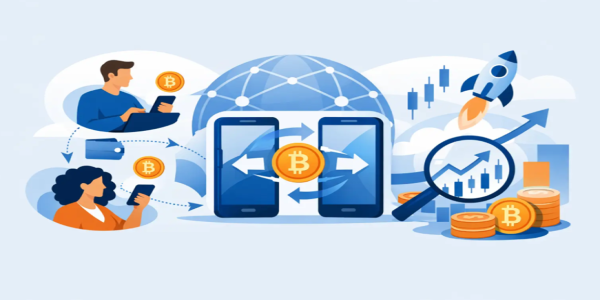
P2P Crypto Adoption Trends to Watch
P2P crypto adoption trends show users moving toward faster, private, flexible trading as access, payment choice, and market freedom become top priorities.
When traders get blocked by slow approvals, narrow payment options, or account limits, they do not stop looking for crypto. They look for another route. That is exactly why p2p crypto adoption trends matter right now. The shift is not just about buying coins differently. It is about who controls access, how fast value moves, and how much freedom users expect from a trading platform.
Peer-to-peer trading has moved beyond its early image as a workaround for niche users. It is becoming a preferred channel for people who want speed, privacy, payment flexibility, and direct market access. For retail traders, side hustlers, arbitrage hunters, and privacy-first buyers, P2P is no longer an alternative path. In many cases, it is the smarter one.
Why p2p crypto adoption trends are accelerating
The biggest driver is frustration. A lot of users still want crypto exposure, but they do not want to spend days getting approved, uploading documents, or waiting through compliance queues before they can act on a price move. In a market that moves around the clock, friction costs money.
P2P trading responds to that problem directly. It shortens the distance between intent and execution. Users can choose how they want to pay, what asset they want to buy, and who they want to transact with. That control is a major reason adoption keeps climbing.
There is also a larger behavioral shift underway. Crypto users are getting more selective about where they trade. They are not just comparing coin listings or fee tables anymore. They are comparing access models. If one platform treats every action like an application process while another lets them move quickly, the choice becomes obvious.
That does not mean P2P is perfect for every trader. Some users still prefer centralized order books, bank-linked dashboards, and highly structured workflows. But the audience that values autonomy is growing fast, and that growth is changing the market.
The move from exchange dependence to user control
One of the clearest trends is that traders want fewer gatekeepers between themselves and the market. Traditional exchanges made crypto more mainstream, but they also introduced layers of rules, hold periods, and restrictions that feel closer to old finance than many users expected.
P2P trading puts more of the process back in the hands of the user. That appeals to people who see crypto as a tool for independence, not just speculation. They want to decide how to fund an account, how to convert value, and when to move capital. They do not want access delayed by bureaucracy.
This matters especially in volatile conditions. When the market is moving, speed becomes part of the strategy. A delay of a few hours can erase an entry opportunity. A delay of a few days can shut a trader out entirely. P2P platforms that reduce waiting and expand payment choice are benefiting from that reality.
Privacy is becoming a competitive advantage
Privacy has gone from a niche concern to a mainstream buying factor. Not every user is trying to disappear. Most simply want control over how much personal information they hand over, how often they repeat verification, and how exposed they are to data collection.
That shift is one of the most important p2p crypto adoption trends to watch. Users are more aware of surveillance, data leaks, platform freezes, and identity risk than they were a few years ago. As a result, they are rewarding platforms that respect discretion and lower barriers.
For privacy-conscious traders, anonymous or low-friction access is not a luxury feature. It is part of the product. It reduces hesitation and creates a more direct relationship with the market. For many users, that alone is enough to change where they trade.
There is still a trade-off. Some users associate heavy verification with safety, while others see it as unnecessary friction. The winning platforms understand that different users define trust differently. In the P2P space, trust often comes from transparency, speed, and transaction control rather than institutional formality.
Payment flexibility is driving mainstream use
Another major growth signal is the rise of flexible payment expectations. Traders do not all want to fund crypto the same way. Some prefer bank transfers, others want digital wallets, local methods, card-based payments, or direct crypto swaps. A platform with narrow rails loses users before the trade even begins.
P2P models are well positioned because they naturally support broader payment variety. That makes them useful for more than speculation. They become practical for everyday buying, selling, transfers, and cross-border value movement.
This is where adoption starts to widen. Once a user sees P2P as more than a backup option, it becomes part of their normal financial behavior. They use it to enter positions faster, rotate between assets, move around banking friction, or take advantage of local market pricing. The more practical the use case, the stronger the retention.
Smaller traders are entering faster
A quiet but important trend is that P2P adoption is not being driven only by high-volume users. Smaller retail traders are entering the space because the experience feels more accessible. They do not need to navigate a complicated institutional interface to get started.
That simplicity matters. Many beginners are interested in crypto but get discouraged when the first step is a long signup process, strict verification sequence, or a dashboard built for professionals. P2P removes some of that intimidation. It feels closer to a direct transaction and less like applying for access.
This does not mean every beginner should jump in without understanding the basics. Price awareness, counterparty caution, and platform selection still matter. But lower friction is clearly expanding the top of the funnel. More people are willing to take the first step when the path feels immediate.
Arbitrage and price discovery are fueling activity
P2P markets are also gaining momentum because active traders see opportunity in them. Pricing can vary across platforms, regions, payment methods, and liquidity pockets. For users who move fast, that creates room for arbitrage and better entries.
This is one of the less discussed but highly practical p2p crypto adoption trends. Traders are not just choosing P2P for convenience. They are choosing it because direct market structures can reveal pricing inefficiencies that more rigid exchange systems smooth out.
The benefit depends on experience. An opportunistic trader may welcome those gaps, while a casual user may simply want a quick and fair transaction. Both can benefit from P2P, but for different reasons. Platforms that serve both groups well are likely to gain share.
Trust is shifting from institutions to systems
As P2P grows, the old question comes up: can users trust it? The answer depends on platform design. Trust in crypto has never been only about brand size. It is also about execution, transparency, wallet functionality, transaction flow, and user control.
Many users now trust systems that let them verify outcomes in real time more than institutions that ask for patience and paperwork. They want clear processes, visible transaction status, straightforward trading tools, and fewer hidden obstacles. They want confidence without the ceremony.
That is where platforms like Budrigan Market fit the moment. The appeal is simple: fast access, broad coin choice, flexible transactions, and fewer barriers between a user and the trade they want to make. For a growing segment of the market, that is not a side benefit. It is the main event.
What comes next for P2P trading
The next phase of growth will likely come from convergence. Users increasingly want one place where they can buy, sell, convert, store, and move across crypto without getting pushed through multiple systems. P2P will keep expanding as part of that larger all-in-one expectation.
We will also likely see stronger demand for interfaces that stay simple while supporting more advanced behavior. That means tools that work for first-time buyers but do not get in the way of active traders. The platforms that win will be the ones that keep access open without making the experience chaotic.
The bigger point is this: P2P is no longer a side lane in crypto. It reflects where user expectations are heading - toward privacy, speed, flexibility, and direct control. Traders are done waiting for permission to participate. If you want access that moves at market speed, pay attention to where P2P goes next, because that is where a lot of crypto freedom is being rebuilt.
Share This Post
P2P crypto adoption trends show users moving toward faster, private, flexible trading as access, payment choice, and market freedom become top priorities.
When traders get blocked by slow approvals, narrow payment options, or account limits, they do not stop looking for crypto. They look for another route. That is exactly why p2p crypto adoption trends matter right now. The shift is not just about buying coins differently. It is about who controls access, how fast value moves, and how much freedom users expect from a trading platform.
Peer-to-peer trading has moved beyond its early image as a workaround for niche users. It is becoming a preferred channel for people who want speed, privacy, payment flexibility, and direct market access. For retail traders, side hustlers, arbitrage hunters, and privacy-first buyers, P2P is no longer an alternative path. In many cases, it is the smarter one.
Why p2p crypto adoption trends are accelerating
The biggest driver is frustration. A lot of users still want crypto exposure, but they do not want to spend days getting approved, uploading documents, or waiting through compliance queues before they can act on a price move. In a market that moves around the clock, friction costs money.
P2P trading responds to that problem directly. It shortens the distance between intent and execution. Users can choose how they want to pay, what asset they want to buy, and who they want to transact with. That control is a major reason adoption keeps climbing.
There is also a larger behavioral shift underway. Crypto users are getting more selective about where they trade. They are not just comparing coin listings or fee tables anymore. They are comparing access models. If one platform treats every action like an application process while another lets them move quickly, the choice becomes obvious.
That does not mean P2P is perfect for every trader. Some users still prefer centralized order books, bank-linked dashboards, and highly structured workflows. But the audience that values autonomy is growing fast, and that growth is changing the market.
The move from exchange dependence to user control
One of the clearest trends is that traders want fewer gatekeepers between themselves and the market. Traditional exchanges made crypto more mainstream, but they also introduced layers of rules, hold periods, and restrictions that feel closer to old finance than many users expected.
P2P trading puts more of the process back in the hands of the user. That appeals to people who see crypto as a tool for independence, not just speculation. They want to decide how to fund an account, how to convert value, and when to move capital. They do not want access delayed by bureaucracy.
This matters especially in volatile conditions. When the market is moving, speed becomes part of the strategy. A delay of a few hours can erase an entry opportunity. A delay of a few days can shut a trader out entirely. P2P platforms that reduce waiting and expand payment choice are benefiting from that reality.
Privacy is becoming a competitive advantage
Privacy has gone from a niche concern to a mainstream buying factor. Not every user is trying to disappear. Most simply want control over how much personal information they hand over, how often they repeat verification, and how exposed they are to data collection.
That shift is one of the most important p2p crypto adoption trends to watch. Users are more aware of surveillance, data leaks, platform freezes, and identity risk than they were a few years ago. As a result, they are rewarding platforms that respect discretion and lower barriers.
For privacy-conscious traders, anonymous or low-friction access is not a luxury feature. It is part of the product. It reduces hesitation and creates a more direct relationship with the market. For many users, that alone is enough to change where they trade.
There is still a trade-off. Some users associate heavy verification with safety, while others see it as unnecessary friction. The winning platforms understand that different users define trust differently. In the P2P space, trust often comes from transparency, speed, and transaction control rather than institutional formality.
Payment flexibility is driving mainstream use
Another major growth signal is the rise of flexible payment expectations. Traders do not all want to fund crypto the same way. Some prefer bank transfers, others want digital wallets, local methods, card-based payments, or direct crypto swaps. A platform with narrow rails loses users before the trade even begins.
P2P models are well positioned because they naturally support broader payment variety. That makes them useful for more than speculation. They become practical for everyday buying, selling, transfers, and cross-border value movement.
This is where adoption starts to widen. Once a user sees P2P as more than a backup option, it becomes part of their normal financial behavior. They use it to enter positions faster, rotate between assets, move around banking friction, or take advantage of local market pricing. The more practical the use case, the stronger the retention.
Smaller traders are entering faster
A quiet but important trend is that P2P adoption is not being driven only by high-volume users. Smaller retail traders are entering the space because the experience feels more accessible. They do not need to navigate a complicated institutional interface to get started.
That simplicity matters. Many beginners are interested in crypto but get discouraged when the first step is a long signup process, strict verification sequence, or a dashboard built for professionals. P2P removes some of that intimidation. It feels closer to a direct transaction and less like applying for access.
This does not mean every beginner should jump in without understanding the basics. Price awareness, counterparty caution, and platform selection still matter. But lower friction is clearly expanding the top of the funnel. More people are willing to take the first step when the path feels immediate.
Arbitrage and price discovery are fueling activity
P2P markets are also gaining momentum because active traders see opportunity in them. Pricing can vary across platforms, regions, payment methods, and liquidity pockets. For users who move fast, that creates room for arbitrage and better entries.
This is one of the less discussed but highly practical p2p crypto adoption trends. Traders are not just choosing P2P for convenience. They are choosing it because direct market structures can reveal pricing inefficiencies that more rigid exchange systems smooth out.
The benefit depends on experience. An opportunistic trader may welcome those gaps, while a casual user may simply want a quick and fair transaction. Both can benefit from P2P, but for different reasons. Platforms that serve both groups well are likely to gain share.
Trust is shifting from institutions to systems
As P2P grows, the old question comes up: can users trust it? The answer depends on platform design. Trust in crypto has never been only about brand size. It is also about execution, transparency, wallet functionality, transaction flow, and user control.
Many users now trust systems that let them verify outcomes in real time more than institutions that ask for patience and paperwork. They want clear processes, visible transaction status, straightforward trading tools, and fewer hidden obstacles. They want confidence without the ceremony.
That is where platforms like Budrigan Market fit the moment. The appeal is simple: fast access, broad coin choice, flexible transactions, and fewer barriers between a user and the trade they want to make. For a growing segment of the market, that is not a side benefit. It is the main event.
What comes next for P2P trading
The next phase of growth will likely come from convergence. Users increasingly want one place where they can buy, sell, convert, store, and move across crypto without getting pushed through multiple systems. P2P will keep expanding as part of that larger all-in-one expectation.
We will also likely see stronger demand for interfaces that stay simple while supporting more advanced behavior. That means tools that work for first-time buyers but do not get in the way of active traders. The platforms that win will be the ones that keep access open without making the experience chaotic.
The bigger point is this: P2P is no longer a side lane in crypto. It reflects where user expectations are heading - toward privacy, speed, flexibility, and direct control. Traders are done waiting for permission to participate. If you want access that moves at market speed, pay attention to where P2P goes next, because that is where a lot of crypto freedom is being rebuilt.