P2P Trading Versus Exchanges: Which Wins?
P2P trading versus exchanges comes down to speed, privacy, pricing, and control. See which model fits your crypto goals and risk tolerance.
The difference between p2p trading versus exchanges gets real the moment you try to move fast. You find an opportunity, you want to buy or sell now, and suddenly the method matters more than the market. Some traders want direct deals, flexible payment options, and more privacy. Others want instant order matching, live charts, and deep liquidity. If you trade crypto with purpose, this choice affects everything from pricing to freedom.
P2P trading versus exchanges: the real split
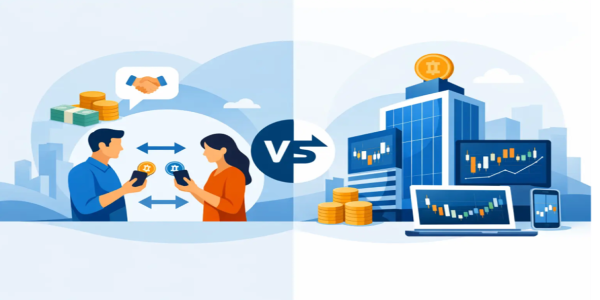
At a basic level, P2P trading lets users trade directly with each other. A platform may facilitate the connection, hold funds in escrow, or provide dispute support, but the transaction itself is between individuals. That model appeals to traders who want flexibility, broader payment methods, and fewer institutional barriers.
Traditional exchanges work differently. They aggregate buyers and sellers into an order book and match trades automatically. You place an order, the system executes it if conditions are met, and the transaction is processed inside the platform's structure. That usually means a faster market experience, but also more platform control over who can trade, how they fund accounts, and what rules they must follow.
This is why p2p trading versus exchanges is not a simple question of which one is better. It is a question of what kind of control you want and what friction you are willing to accept.
When P2P feels better
P2P trading stands out when flexibility matters more than market structure. If you want to buy crypto using payment methods that do not fit neatly into a standard exchange checkout flow, P2P can be the faster route. It also gives users room to negotiate price, timing, and payment details with another person instead of accepting a platform's narrow rails.
Privacy-conscious traders often lean toward P2P for the same reason. The experience can feel more direct and less invasive. For users who do not want to deal with long onboarding queues, repeated identity checks, or delays before they can act, P2P has obvious appeal.
There is also a practical advantage for people operating in fragmented markets. If you are looking for arbitrage gaps, local pricing differences, or access to buyers and sellers using specific regional payment tools, P2P can open doors that centralized systems often close.
That said, freedom is not the same as simplicity. P2P requires attention. You need to evaluate counterparties, understand payment timing, and follow the platform's protection process carefully. The trade can be worth it, but it is not passive.
The trade-off behind the freedom
The strongest benefit of P2P is autonomy. The strongest weakness is that autonomy puts more responsibility on the trader. If you are careless, rushed, or unfamiliar with common scam patterns, direct person-to-person trading can expose you to avoidable risk.
A good P2P environment reduces that risk with escrow and clear dispute handling, but the user still has to operate with discipline. You are not just clicking buy. You are participating in a negotiated transaction.
When exchanges feel easier
Exchanges appeal to traders who want speed inside a structured market. If your goal is to place a trade in seconds, react to price movement, or move through multiple assets with minimal pause, exchange-based trading often feels cleaner. The order book is visible, pricing is transparent in real time, and execution can happen instantly when liquidity is available.
For active traders, this matters. Scalpers, swing traders, and anyone using technical setups usually prefer an exchange environment because it supports faster decision-making. The data is centralized, the workflow is standardized, and the interface is built for repeat action.
Exchanges can also feel safer to newer users who do not want to negotiate with strangers or manage trade settlement manually. There is comfort in a system where the platform handles matching, balances, and execution.
But convenience has a cost. In many cases, that cost shows up as slower onboarding, stricter access controls, limited payment methods, account restrictions, or withdrawal friction. If a platform wants extensive verification before you can fully use your account, the opportunity window may close before your account opens.
The hidden price of convenience
A lot of traders assume exchanges are automatically better because they look more professional. The reality is more mixed. A polished order book does not help if you cannot access it quickly, if your preferred funding method is blocked, or if your activity triggers limits that slow you down.
This is where many retail traders get frustrated. The platform promises instant markets, but the actual user experience can involve waiting, submitting documents, and working around restrictions that have nothing to do with the trade itself.
Price, liquidity, and execution
If you care most about tight spreads and immediate execution, exchanges usually have the edge. Their matching engines are designed for market activity at scale, which can make pricing more efficient, especially on major coins with high volume.
P2P pricing is more variable. Sometimes that works in your favor. You may find a seller willing to move at a discount for speed, or a buyer willing to pay more for a preferred payment method. Other times, P2P prices can be less competitive than exchange rates because the transaction includes convenience, local demand, or payment-related premiums.
So the better deal depends on context. If you are trading large-cap assets in a liquid market, exchanges often win on execution quality. If you are solving for access, payment flexibility, or a local market imbalance, P2P can create value that does not show up on a chart.
Privacy and control
This is where the gap gets wider.
Many traders are not just comparing features. They are deciding how much of their financial activity they want to expose and how many gates they are willing to pass through. P2P often feels more aligned with crypto's original promise: direct transactions, fewer intermediaries, and more user control.
Exchanges, especially mainstream ones, tend to move in the opposite direction. More oversight, more compliance layers, more approval steps. Some traders accept that as the price of access. Others see it as unnecessary drag.
If privacy, unrestricted access, and low-friction entry are priorities for you, then the answer in p2p trading versus exchanges may not be complicated at all. You are probably not looking for more permission. You are looking for more freedom.
Which option works better for beginners?
Beginners are often told to avoid P2P because it sounds more complex. That advice is too broad.
A beginner who wants simple chart-based trading with standard funding options may feel more comfortable on an exchange. The system is structured, the process is linear, and there is less direct interaction with other users.
But a beginner who keeps running into verification delays, rejected payment methods, or regional barriers may actually find P2P more practical. Not easier in every sense, but more usable. Access matters. If a platform makes it difficult to start, the beginner experience is already broken.
The key is not whether you are new. It is whether the platform design matches your goal. If you want immediate market access with fewer blockers, a low-friction crypto platform that supports both direct trading flexibility and broader asset access can be a far better fit than a compliance-heavy exchange maze.
A smarter way to think about p2p trading versus exchanges
Do not treat this like a winner-take-all debate. Most serious traders eventually realize both models have value.
Use exchanges when you need high-speed execution, visible depth, and rapid position management. Use P2P when you need flexible funding, direct transactions, privacy, or access that standard platforms keep slowing down. The smarter move is choosing the route that protects your momentum instead of forcing every trade through the same channel.
That is also why newer platforms are gaining attention. Traders want more than a rigid exchange model. They want optionality - spot trading when speed matters, peer-to-peer access when flexibility matters, and wallet and conversion tools that do not turn every action into paperwork. That is the gap Budrigan Market is built to address.
Crypto moves fast. Your trading setup should not trap you in delays, limits, or unnecessary exposure. The best choice is the one that keeps you in control, lets you act when timing matters, and removes friction between decision and execution.
Share This Post
P2P trading versus exchanges comes down to speed, privacy, pricing, and control. See which model fits your crypto goals and risk tolerance.
The difference between p2p trading versus exchanges gets real the moment you try to move fast. You find an opportunity, you want to buy or sell now, and suddenly the method matters more than the market. Some traders want direct deals, flexible payment options, and more privacy. Others want instant order matching, live charts, and deep liquidity. If you trade crypto with purpose, this choice affects everything from pricing to freedom.
P2P trading versus exchanges: the real split
At a basic level, P2P trading lets users trade directly with each other. A platform may facilitate the connection, hold funds in escrow, or provide dispute support, but the transaction itself is between individuals. That model appeals to traders who want flexibility, broader payment methods, and fewer institutional barriers.
Traditional exchanges work differently. They aggregate buyers and sellers into an order book and match trades automatically. You place an order, the system executes it if conditions are met, and the transaction is processed inside the platform's structure. That usually means a faster market experience, but also more platform control over who can trade, how they fund accounts, and what rules they must follow.
This is why p2p trading versus exchanges is not a simple question of which one is better. It is a question of what kind of control you want and what friction you are willing to accept.
When P2P feels better
P2P trading stands out when flexibility matters more than market structure. If you want to buy crypto using payment methods that do not fit neatly into a standard exchange checkout flow, P2P can be the faster route. It also gives users room to negotiate price, timing, and payment details with another person instead of accepting a platform's narrow rails.
Privacy-conscious traders often lean toward P2P for the same reason. The experience can feel more direct and less invasive. For users who do not want to deal with long onboarding queues, repeated identity checks, or delays before they can act, P2P has obvious appeal.
There is also a practical advantage for people operating in fragmented markets. If you are looking for arbitrage gaps, local pricing differences, or access to buyers and sellers using specific regional payment tools, P2P can open doors that centralized systems often close.
That said, freedom is not the same as simplicity. P2P requires attention. You need to evaluate counterparties, understand payment timing, and follow the platform's protection process carefully. The trade can be worth it, but it is not passive.
The trade-off behind the freedom
The strongest benefit of P2P is autonomy. The strongest weakness is that autonomy puts more responsibility on the trader. If you are careless, rushed, or unfamiliar with common scam patterns, direct person-to-person trading can expose you to avoidable risk.
A good P2P environment reduces that risk with escrow and clear dispute handling, but the user still has to operate with discipline. You are not just clicking buy. You are participating in a negotiated transaction.
When exchanges feel easier
Exchanges appeal to traders who want speed inside a structured market. If your goal is to place a trade in seconds, react to price movement, or move through multiple assets with minimal pause, exchange-based trading often feels cleaner. The order book is visible, pricing is transparent in real time, and execution can happen instantly when liquidity is available.
For active traders, this matters. Scalpers, swing traders, and anyone using technical setups usually prefer an exchange environment because it supports faster decision-making. The data is centralized, the workflow is standardized, and the interface is built for repeat action.
Exchanges can also feel safer to newer users who do not want to negotiate with strangers or manage trade settlement manually. There is comfort in a system where the platform handles matching, balances, and execution.
But convenience has a cost. In many cases, that cost shows up as slower onboarding, stricter access controls, limited payment methods, account restrictions, or withdrawal friction. If a platform wants extensive verification before you can fully use your account, the opportunity window may close before your account opens.
The hidden price of convenience
A lot of traders assume exchanges are automatically better because they look more professional. The reality is more mixed. A polished order book does not help if you cannot access it quickly, if your preferred funding method is blocked, or if your activity triggers limits that slow you down.
This is where many retail traders get frustrated. The platform promises instant markets, but the actual user experience can involve waiting, submitting documents, and working around restrictions that have nothing to do with the trade itself.
Price, liquidity, and execution
If you care most about tight spreads and immediate execution, exchanges usually have the edge. Their matching engines are designed for market activity at scale, which can make pricing more efficient, especially on major coins with high volume.
P2P pricing is more variable. Sometimes that works in your favor. You may find a seller willing to move at a discount for speed, or a buyer willing to pay more for a preferred payment method. Other times, P2P prices can be less competitive than exchange rates because the transaction includes convenience, local demand, or payment-related premiums.
So the better deal depends on context. If you are trading large-cap assets in a liquid market, exchanges often win on execution quality. If you are solving for access, payment flexibility, or a local market imbalance, P2P can create value that does not show up on a chart.
Privacy and control
This is where the gap gets wider.
Many traders are not just comparing features. They are deciding how much of their financial activity they want to expose and how many gates they are willing to pass through. P2P often feels more aligned with crypto's original promise: direct transactions, fewer intermediaries, and more user control.
Exchanges, especially mainstream ones, tend to move in the opposite direction. More oversight, more compliance layers, more approval steps. Some traders accept that as the price of access. Others see it as unnecessary drag.
If privacy, unrestricted access, and low-friction entry are priorities for you, then the answer in p2p trading versus exchanges may not be complicated at all. You are probably not looking for more permission. You are looking for more freedom.
Which option works better for beginners?
Beginners are often told to avoid P2P because it sounds more complex. That advice is too broad.
A beginner who wants simple chart-based trading with standard funding options may feel more comfortable on an exchange. The system is structured, the process is linear, and there is less direct interaction with other users.
But a beginner who keeps running into verification delays, rejected payment methods, or regional barriers may actually find P2P more practical. Not easier in every sense, but more usable. Access matters. If a platform makes it difficult to start, the beginner experience is already broken.
The key is not whether you are new. It is whether the platform design matches your goal. If you want immediate market access with fewer blockers, a low-friction crypto platform that supports both direct trading flexibility and broader asset access can be a far better fit than a compliance-heavy exchange maze.
A smarter way to think about p2p trading versus exchanges
Do not treat this like a winner-take-all debate. Most serious traders eventually realize both models have value.
Use exchanges when you need high-speed execution, visible depth, and rapid position management. Use P2P when you need flexible funding, direct transactions, privacy, or access that standard platforms keep slowing down. The smarter move is choosing the route that protects your momentum instead of forcing every trade through the same channel.
That is also why newer platforms are gaining attention. Traders want more than a rigid exchange model. They want optionality - spot trading when speed matters, peer-to-peer access when flexibility matters, and wallet and conversion tools that do not turn every action into paperwork. That is the gap Budrigan Market is built to address.
Crypto moves fast. Your trading setup should not trap you in delays, limits, or unnecessary exposure. The best choice is the one that keeps you in control, lets you act when timing matters, and removes friction between decision and execution.