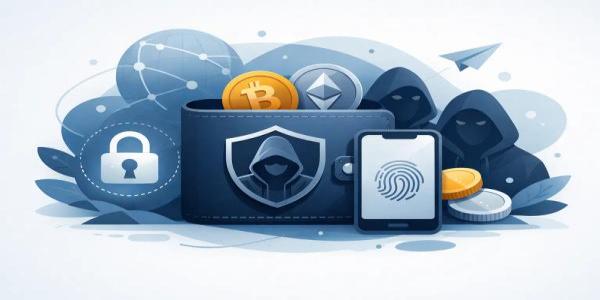
Guide to Anonymous Crypto Wallets
A practical guide to anonymous crypto wallets, covering privacy levels, wallet types, key risks, and smart setup choices for faster trading freedom.
Privacy in crypto usually breaks the moment you reuse an address, connect a wallet to a tracked app, or buy through a platform that wants your whole identity before you can move a dollar. That is exactly why a guide to anonymous crypto wallets matters. If you want faster access, fewer gatekeepers, and more control over how you store and move digital assets, you need to understand what "anonymous" really means and where the trade-offs start.
What anonymous crypto wallets actually do
An anonymous crypto wallet does not make you invisible. It gives you a way to hold and transfer crypto without tying every action to your full personal profile. That distinction matters.
Most wallets do not ask for your name or documents when you create them. On the surface, that feels private. But blockchain activity is public, and wallet behavior can still reveal patterns. If funds move from a fully verified exchange account into a wallet you control, your privacy is already weaker than many users assume.
So the real value of anonymous wallets is control. You control the keys. You control when and where you transact. You reduce exposure to platforms that want extensive verification just to let you hold or swap assets. For traders who want speed and freedom, that is a practical advantage, not just an ideological one.
A guide to anonymous crypto wallets starts with one question
Are you trying to protect identity, protect balances, or protect activity patterns?
Those are not the same thing. Some users want a wallet with no signup and no document checks. Others want stronger transaction privacy on-chain. Others simply want to separate their trading activity from their everyday financial footprint.
If your goal is basic pseudonymity, a standard non-custodial wallet may be enough. If your goal is deeper transaction privacy, wallet choice alone will not solve it. You also need to think about network selection, address reuse, funding methods, and how you interact with exchanges and apps.
That is where many people get it wrong. They obsess over wallet branding and ignore the operational habits that expose them.
Custodial vs. non-custodial: this is the first real fork
A custodial wallet means a platform holds the keys for you. It may feel easy, but it also means your access, limits, and privacy can depend on that company’s rules. If the provider demands identity checks later, freezes activity, or restricts certain transactions, your freedom shrinks fast.
A non-custodial wallet puts the keys in your hands. That is the better fit for users who value anonymity and unrestricted access. You can create one quickly, move funds on your schedule, and avoid handing over personal documents just to get started.
There is a catch. More control means more responsibility. Lose your recovery phrase and there is no help desk that can restore your balance. For beginners, that can feel harsh. For serious traders, it is often the price of independence.
Hot wallets, cold wallets, and what fits your style
Hot wallets stay connected to the internet. They are fast, convenient, and ideal for active trading, swaps, and everyday transfers. If you move in and out of positions often, speed matters. A hot wallet gives you that edge.
Cold wallets store keys offline. They are stronger for long-term security because they reduce online exposure. If you are holding larger balances, cold storage deserves serious attention.
For many users, the best answer is not either-or. It is both. Keep trading funds in a hot wallet and store larger reserves in cold storage. That setup gives you speed without forcing your full stack into constant online risk.
Privacy levels vary by chain more than most users expect
Not every blockchain offers the same privacy profile. Bitcoin and Ethereum are transparent by design. Transactions can be analyzed, grouped, and often traced through common patterns. A wallet on those networks can still be useful for pseudonymous control, but it does not magically hide your history.
Privacy-focused coins and networks can add another layer, but they come with trade-offs. Liquidity may be lower. Exchange support may be narrower. Some users also find that privacy-enhancing ecosystems demand more technical understanding.
If your priority is broad market access and fast execution, you may accept a more transparent chain while tightening your wallet practices. If your priority is deeper privacy, you may choose networks built for it, knowing convenience can drop.
The habits that make or break wallet anonymity
Most privacy failures come from behavior, not software.
Reusing wallet addresses is one of the biggest mistakes. It makes your transaction history easier to map. Separating activities across different addresses or wallets creates more distance between holdings, trades, and transfers.
Funding source matters too. If you send assets from a fully identified account directly into your private wallet, that link exists whether you like it or not. The wallet may be non-custodial, but your acquisition path can still reduce anonymity.
Device hygiene matters more than people want to admit. If your phone or browser is full of trackers, extensions, and logged-in financial apps, your wallet activity can be correlated in ways that undermine your privacy goals. Anonymous crypto is not just about keys. It is about environment.
Choosing the right wallet for fast, private access
A good wallet for privacy-minded traders should be easy to create, simple to back up, and flexible across assets. It should let you manage your own keys and move quickly when market conditions change.
Look for wallets with clean address management, straightforward recovery systems, and support for the assets you actually trade. Fancy features mean very little if they slow you down or make mistakes more likely.
You should also think about how the wallet fits your broader flow. Are you using it for short-term trading, peer-to-peer transfers, long-term storage, or arbitrage between markets? The right answer depends on use case. A wallet that is perfect for fast swaps may be weak for high-balance storage. A wallet built for deep cold security may feel clunky if you trade every day.
That is why serious users build a system, not just download an app.
Security is part of anonymity
A compromised wallet is not private. It is exposed.
If someone gains access to your keys, device, seed phrase, or backup, your balances and transaction history can become someone else’s opportunity. Real privacy starts with control, and control starts with basic security discipline.
Write down your recovery phrase offline. Do not store it in screenshots, cloud notes, or casual messages to yourself. Use strong device security. Be careful with browser extensions and fake wallet apps. If you are holding meaningful value, treat wallet setup like financial infrastructure, not like another social app signup.
That may sound strict, but this is the game. Freedom works best when it comes with discipline.
Where anonymous wallets fit into a trading-first strategy
For active users, anonymous wallets are not just about hiding. They are about reducing friction.
When you are not stuck in slow onboarding loops or waiting on approval layers, you can move funds faster, respond to price action sooner, and keep your strategy under your control. That matters for peer-to-peer transactions, quick conversions, and traders who want more direct access to opportunity.
This is also why privacy-minded exchanges and wallet-enabled trading platforms appeal to so many users. They cut out unnecessary barriers between intent and execution. Budrigan Market is built around that same reality: faster access, broad crypto choice, and fewer obstacles standing between you and your next move.
Still, freedom is not the same as recklessness. You want speed, but you also want a wallet strategy that protects your options over time.
The biggest misconception in any guide to anonymous crypto wallets
People think the wallet alone creates anonymity. It does not.
An anonymous wallet is one piece of a larger privacy setup. Your funding method, chain choice, address behavior, device setup, and trading habits all shape your exposure. Ignore that, and even a strong wallet becomes a weak shield.
The smarter approach is layered. Use a non-custodial wallet. Avoid unnecessary identity exposure. Separate activities where possible. Store larger balances more carefully than daily trading funds. Keep your process lean, but do not confuse simple with careless.
If you want open market access without handing over more than necessary, anonymous crypto wallets are a powerful starting point. Just remember that privacy is built, not downloaded. The more intentional your setup, the more freedom you keep when it is time to trade.
Share This Post
Recent Posts
-

P2P Offer Comparison: Find Better Crypto Deals
06 Oct 2026
-

Stablecoin Merchant Payment Example: A Real Sale
06 Oct 2026
-
Binary Trading: Know the Risk Before You Trade
06 Oct 2026
-
Account Funding Options for Faster Crypto Trades
06 Oct 2026
-
Custody Model Comparison for Crypto Traders
06 Oct 2026