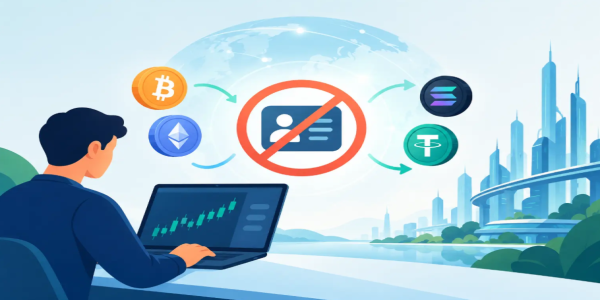
What the Future of No KYC Exchanges Looks Like
The future of no KYC exchanges will be shaped by privacy demand, smarter safeguards, self-custody, and changing rules for crypto traders worldwide ahead.
A trader sees a fast-moving market, finds an opportunity, and then gets stopped by a request for documents, a review period, or a withdrawal hold. That gap between intent and execution is exactly why the future of no KYC exchanges matters. Crypto was built around direct ownership and open access. Many users still expect the ability to buy, swap, store, and move digital assets without turning every transaction into a lengthy banking-style application.
No KYC does not mean users want chaos. It means they want privacy, speed, and control without unnecessary friction. The platforms that define the next stage of crypto trading will need to protect those values while adapting to a market where security expectations, technology, and regulations continue to change.
Why No KYC Access Still Has Momentum
Identity verification became standard across major centralized exchanges because it fits the traditional financial model. It creates a record, slows onboarding, and gives platforms a framework for managing compliance requirements. For some users, that process is acceptable. For others, it creates a barrier that feels out of place in a global, always-on crypto market.
Privacy-conscious traders may not want to provide personal documents to multiple platforms. Newcomers may want to test a small trade before sharing sensitive information. Active traders may simply refuse to wait while a price moves. International users can also face verification delays when local documents, banking systems, or regional restrictions do not fit a platform's standard process.
The demand is not disappearing because it is rooted in a simple preference: users want fewer gatekeepers between their funds and their decisions. As mainstream exchanges add more checks, limits, and account restrictions, low-friction alternatives become more visible.
That does not mean every trader will choose a no KYC exchange. Larger investors, institutions, and users who need direct bank integrations may prefer fully verified services. The market is not moving toward one universal model. It is splitting into options, and users will choose based on their goals.
The Future of No KYC Exchanges Will Be More Selective
The early idea of a no KYC exchange was often simple: create an account, deposit crypto, and trade. The next generation will be more sophisticated. Fast access will remain central, but platforms will increasingly use technology to manage risk without making every legitimate user surrender their privacy on day one.
That can include transaction monitoring designed to flag clearly suspicious patterns, wallet-level risk signals, withdrawal protections, and stronger account security controls. These measures are different from demanding a passport before a user can make a basic crypto swap. The goal is to focus on harmful activity rather than treating every customer as a problem waiting to happen.
This is where the real trade-off appears. A platform that ignores security can expose users to fraud, compromised accounts, and unreliable liquidity. A platform that copies every restrictive practice of traditional finance loses the reason many users came to crypto in the first place. The strongest exchanges will build a middle path: private by default where possible, firm against abuse where necessary.
Privacy Will Become a Product Standard
The market is gradually learning that privacy is not a niche feature. It is a practical expectation.
Users protect their wallets with private keys. They avoid sharing recovery phrases. They think carefully about public transaction records. It follows that many also want control over who holds their personal identity data and how long it is retained. Data breaches have made this concern more immediate. Once a document, address, or selfie is stored in a database, users cannot easily take it back.
Future platforms will compete on how little personal data they need, how clearly they explain their data practices, and how securely they protect the information they do collect. No KYC access is part of that conversation, but so is better privacy design across wallets, P2P markets, and conversion services.
Self-Custody Will Shape Expectations
Centralized exchanges are convenient, but self-custody has changed what users expect from financial platforms. A growing number of traders want the freedom to hold their own assets, use multiple wallets, and move between services without building their entire financial life around a single account.
No KYC exchanges can fit naturally into that behavior when they support quick crypto-to-crypto conversions, flexible withdrawals, and simple wallet connectivity. Users do not necessarily want to park every asset on an exchange. They want a place to act when opportunity appears, then return assets to a wallet they control.
The platforms that earn long-term trust will make those flows simple. Deposits, trades, conversions, and withdrawals should be clear, fast, and transparent. Freedom is not just about skipping forms. It is about having practical control over your assets after the trade is complete.
What Traders Should Demand From a No KYC Platform
Low-friction onboarding is valuable, but it should not be the only factor in a trader's decision. Privacy without basic protections can become expensive. Before using any exchange, traders should look closely at how it handles security, liquidity, fees, and withdrawals.
A clear trading interface matters because fast access means little if orders are confusing or pricing is difficult to understand. A broad selection of assets matters when traders want to move beyond the same handful of large-cap coins. Payment flexibility can also matter, especially for users who want options beyond a single funding route.
Security should stay at the center of the decision. Strong passwords, two-factor authentication where available, careful device habits, and independent wallet security remain the user's responsibility. No KYC does not remove the need for smart trading practices. It removes unnecessary steps from the access point.
Traders should also understand the difference between privacy and invisibility. Blockchain activity can be publicly traceable, and laws vary by location. Users are responsible for following applicable tax rules and legal requirements. Real financial freedom works best when it is paired with informed decisions.
Regulation Will Create Pressure, Not an Ending
Regulation is one of the biggest variables in the future of no KYC exchanges. Authorities in the United States and elsewhere are paying closer attention to how crypto platforms manage illicit finance, consumer protection, custody, and cross-border activity. That pressure will continue.
But regulation is unlikely to erase the user demand for private, direct access to digital assets. Instead, it may push the industry toward clearer distinctions. Some services will operate as fully verified, institution-facing marketplaces. Others will focus on limited-risk transactions, decentralized trading tools, P2P functionality, or self-custody-first experiences.
Technology will also influence the outcome. Decentralized infrastructure, smart contracts, non-custodial swaps, and privacy-preserving identity tools could allow users to prove specific facts without handing over an entire identity profile. For example, future systems may make it easier to confirm eligibility or jurisdictional requirements while revealing less personal data than a traditional onboarding process requires.
That transition will not happen overnight, and it will not be identical in every market. Still, it points toward a more interesting future than a simple choice between total surveillance and zero accountability.
Speed Will Remain the Competitive Edge
Markets do not wait for verification queues. Crypto trades around the clock, price differences appear across platforms, and P2P opportunities can disappear in minutes. For users who value flexibility, the platform that reduces unnecessary delays has a genuine advantage.
This is especially relevant for arbitrage-minded traders and users converting between crypto and USD. Every additional step can affect timing, price, and confidence. Fast activation, direct trading tools, accessible wallets, and a wide asset range give users more ways to respond instead of watching from the sidelines.
Budrigan Market is built around that belief: digital asset access should feel direct, not buried under avoidable friction. The future belongs to platforms that respect a user's time while giving them practical tools to trade, convert, and manage crypto on their terms.
A More Open Crypto Market Is Taking Shape
The future will not reward platforms merely for saying "no KYC." Users will expect more. They will look for reliable execution, fair pricing, secure access, transparent rules, and genuine control over their assets. Privacy gets attention, but trust keeps traders coming back.
For traders, the opportunity is to choose platforms with intention. Keep your security habits sharp, understand the risks of every transaction, and use the level of access that fits your goals. Crypto was never meant to force everyone into the same financial lane. The next generation of exchanges can keep that promise alive by making access faster, private, and built for people ready to act.
Share This Post
Recent Posts
-

How to Trade Altcoins Efficiently With a Plan
14 Sep 2026
-

A Guide to Decentralized Crypto Exchanges
14 Sep 2026
-

A Practical Guide to Crypto Arbitrage Trading
14 Sep 2026
-

Anonymous Crypto Wallet Options for More Control
10 Sep 2026
-
