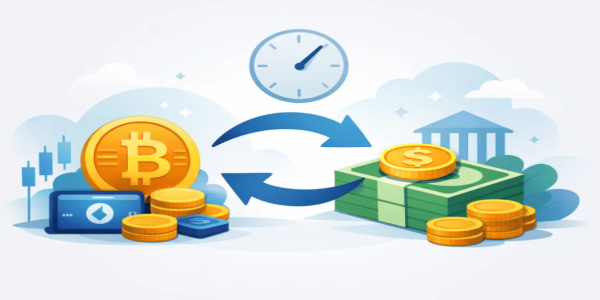
Crypto to USD Conversion Without the Wait
Crypto to USD conversion can move at market speed. Learn how rates, fees, timing, and execution affect the dollars you receive from every trade you make.
A crypto balance can look impressive until you need to know what it is worth in dollars right now. That is where crypto to USD conversion becomes more than a number on a screen. It is the moment you turn market movement into a usable dollar value, decide whether to hold or sell, and take control of your next move.
For active traders, speed matters. A price can change between the time you check a quote and the time your conversion is completed. For newcomers, clarity matters just as much. You need to know what rate you are receiving, what fees apply, and how much USD you will actually have after the transaction.
What Crypto to USD Conversion Means
Crypto to USD conversion is the exchange of a digital asset, such as Bitcoin, Ethereum, USDT, or Solana, for its value in US dollars. Depending on the platform and the asset, the result may appear as a USD balance, a dollar-linked stablecoin balance, or funds available through a supported fiat withdrawal method.
The basic idea is simple: your crypto amount is multiplied by the available market rate, then any spread or conversion fee is applied. If you convert 0.1 BTC when Bitcoin is quoted at $70,000, the starting value is $7,000. The final amount depends on the rate locked in at execution and the transaction costs shown before you confirm.
That final figure is what counts. A platform may advertise a strong market price, but the number that reaches your USD balance is the number that should guide your decision.
Why the Rate Changes So Fast
Crypto trades around the clock. Unlike traditional stock markets, there is no single closing bell that pauses price discovery. Buyers and sellers are constantly placing orders, liquidity shifts across markets, and news can change demand in seconds.
A displayed conversion rate is usually based on the current market price, but it can move before your transaction is executed. This difference is often called price movement or slippage. It is more noticeable when markets are volatile, when you are converting a large amount, or when the coin has lower trading activity.
For example, converting a widely traded asset such as BTC or ETH generally provides deeper liquidity than converting a smaller altcoin. That does not mean smaller assets cannot be converted. It means you should pay closer attention to the quote, the available market depth, and the final amount you will receive.
The Real Cost of Converting Crypto to USD
The market price is only one part of the equation. A smart conversion decision considers the full cost of execution. There are three common factors: the conversion rate, the platform fee, and the spread between the buy and sell side of the market.
A fee is usually easy to recognize because it is shown as a separate charge or percentage. A spread is less obvious. It is the difference between the price at which an asset can be bought and sold at a given moment. Platforms may build part of their compensation into that difference rather than showing one standalone fee.
Neither approach is automatically better. A zero-fee message may still include a spread, while a visible fee can come with a highly competitive rate. Compare the final USD amount, not just the headline claim. Before confirming, look for the exact crypto amount leaving your wallet, the conversion quote, the fees if listed, and the USD amount arriving in your balance.
Timing Your Conversion Without Guessing the Top
Nobody consistently sells at the exact peak. Waiting for the perfect number can turn a clear plan into a missed opportunity. A better approach is to decide why you are converting before you watch every price candle.
If you need dollars for an expense, your priority may be certainty. If you are taking profit after a strong move, you may choose to convert a portion while leaving the rest in crypto. If you are reducing risk during a volatile period, smaller staged conversions can help avoid putting your entire decision on one market moment.
Staging is especially useful for traders with larger positions. Instead of converting everything at one quote, you can break the amount into several transactions over time. This may reduce the impact of a sudden price swing, although it can also mean missing a favorable move if the market rises quickly. There is no universal best method. Your time horizon, risk tolerance, and need for USD should lead the decision.
A Fast Crypto to USD Conversion Checklist
Before you confirm a conversion, pause long enough to verify the essentials. This takes moments and can prevent an expensive mistake.
- Confirm the asset and amount. Similar token names and networks can create confusion.
- Review the live quote and the final USD amount, not only the advertised price.
- Check whether a fee, spread, or withdrawal charge affects the result.
- Make sure the destination is correct, whether that is a USD balance, stablecoin wallet, or supported payout method.
- Save your transaction record for personal tracking and any tax reporting obligations that apply to you.
That last step is not paperwork for paperwork's sake. Conversions can create taxable events depending on where you live and how the asset was acquired. Keep your own records of dates, amounts, cost basis, and proceeds. If your situation is complex, get guidance from a qualified tax professional.
USD, Stablecoins, and Cash Access Are Different
Traders often use the word “USD” loosely, but a USD balance, USDT, USDC, and cash in a bank account are not the same thing. Each serves a different purpose.
A platform USD balance may make it easier to move into another trade without waiting for a blockchain confirmation. A dollar-linked stablecoin can provide on-chain flexibility for transfers, P2P activity, and crypto market access. Cash withdrawal gives you spending power outside the crypto ecosystem, but it may involve payout timing, banking rules, or additional processing charges.
Choose the destination based on what you plan to do next. If you are waiting for another trading opportunity, staying in a dollar-denominated balance may be practical. If you need to send value on-chain, a stablecoin may make more sense. If the goal is everyday spending, confirm the available withdrawal route before converting.
Convert With a Clear Plan, Not Panic
Volatility creates urgency, and urgency can lead to rushed decisions. When a coin drops sharply, converting may protect remaining value. When a coin climbs quickly, converting may secure gains. Both can be reasonable. The mistake is acting only because a chart creates fear or excitement.
Set simple rules before the market tests you. You might decide to convert a percentage after a certain gain, reduce exposure when a position becomes too large relative to your portfolio, or hold a set amount in USD for future entries. These rules do not remove risk, but they replace impulse with a repeatable process.
Budrigan Market is built for traders who value direct market access, broad asset choice, and fewer barriers between a decision and execution. Whether you are converting a major coin or moving out of an altcoin position, keep your focus on the quote, the final amount, and the next action you want your dollars to support.
Make the Dollar Value Work for You
The goal of conversion is not simply to exit crypto. It is to give your capital a job. Dollars can be held for stability, used to lock in gains, deployed into a new opportunity, or moved toward a real-world expense. The right choice depends on your plan, not the noise around it.
Watch the final USD amount, understand the terms before you confirm, and move when the conversion supports your own strategy. Financial freedom starts with knowing exactly what your assets are worth and deciding what happens next.
Share This Post
Recent Posts
-

Spot Trading vs P2P Trading: Which Fits You?
07 Sep 2026
-

Spot Crypto Trading Strategies for Smarter Moves
07 Sep 2026
-

Top Features of Spot Exchanges That Matter
07 Sep 2026
-

7 Best Privacy Coins for Trading in 2026
04 Sep 2026
-

Peer-to-Peer Crypto Platform Review Checklist
04 Sep 2026