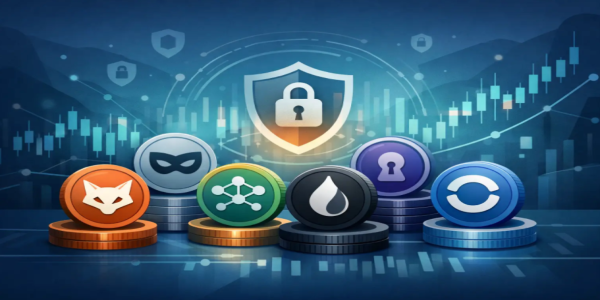
7 Best Privacy Coins for Trading in 2026
Compare the best privacy coins for trading, from Monero to Zcash, with liquidity, volatility, access, and risk factors that matter to active traders.
Privacy is not a single switch. Some coins hide every transaction by default, while others let users choose when to reveal details. For active traders, the best privacy coins for trading are the ones that balance real privacy technology with enough liquidity, market interest, and exchange access to make entering and exiting a position practical.
Privacy-focused assets can move fast when regulation headlines, exchange listings, network upgrades, or broader market momentum hit. That creates opportunity, but it also creates extra risk. Trade the market in front of you, understand what each project actually does, and never confuse a privacy feature with a guaranteed price catalyst.
What Makes a Privacy Coin Tradable?
A strong privacy coin is more than an asset with anonymous branding. Traders should look at the mechanism behind the privacy claim, daily trading volume, spread between bids and asks, wallet support, and where the asset can legally be accessed in their jurisdiction.
Liquidity matters because a great chart means little if a market order creates heavy slippage. Coins with deeper markets usually offer cleaner entries, more dependable exits, and better conditions for short-term strategies. Volatility matters too, but not in isolation. A coin that moves 20% on thin volume can reverse just as quickly when buyers disappear.
The privacy model also changes the narrative around a coin. Default-private networks appeal to users who want confidentiality built into every transfer. Optional-privacy networks can appeal to users who want the ability to disclose transaction information when needed. Neither approach automatically makes one asset a better trade. Your strategy, holding period, and available market pairs should decide that.
5 Best Privacy Coins for Trading
Monero (XMR)
Monero is the reference point for default-on transaction privacy. Its protocol is designed to obscure sender, receiver, and amount information, making it one of the most recognized names in the privacy category. That recognition gives XMR a strong identity during periods when the market is focused on financial surveillance, fungibility, or personal control.
For trading, Monero's key advantage is its established community and long market history. It is often one of the first assets traders watch when privacy coins start attracting volume. The trade-off is regulatory pressure. Access can vary significantly by location and venue, and listing changes can affect liquidity or cause sudden volatility. Watch market depth, not just the headline price.
Zcash (ZEC)
Zcash takes a different route. It uses zero-knowledge proof technology and offers shielded transactions alongside transparent ones. That optional model is central to the ZEC story: users can choose greater privacy while retaining the ability to use transparent addresses where disclosure is useful.
ZEC can attract traders who follow technology developments, adoption of shielded pools, and changes in market perception around selective privacy. It tends to be a news-sensitive asset, so planned upgrades and ecosystem announcements deserve attention. Before taking a position, check which transaction types and wallets are supported in the market environment you use. The technology is sophisticated, but a trade still depends on volume, timing, and risk control.
Dash (DASH)
Dash is often included in privacy-coin conversations because of its PrivateSend feature, although its broader identity is built around digital payments, fast transactions, and user-friendly spending. That makes it different from projects where privacy is the entire value proposition.
For traders, Dash can offer a distinct angle. Its price may respond not only to privacy-sector sentiment but also to payment adoption narratives and broader altcoin rotation. The downside is that the market may not always price Dash as a pure privacy play. Treat it as a hybrid asset. If you are trading a privacy narrative, compare its relative strength against XMR and ZEC rather than assuming all three will move together.
Secret Network (SCRT)
Secret Network brings privacy to smart contract activity rather than focusing only on private peer-to-peer transfers. Its core idea is confidential computation, allowing applications to use private inputs and outputs. That places SCRT at the intersection of privacy, decentralized finance, and application-layer crypto.
SCRT may suit traders looking for higher-beta exposure to a smaller privacy-related ecosystem. It can react sharply to product launches, network activity, and shifts in demand for privacy-preserving apps. That potential comes with thinner liquidity and greater execution risk than the larger names. Use limit orders where available, size positions carefully, and avoid treating a low-priced token as automatically cheap.
Firo (FIRO)
Firo is a dedicated privacy project with a long-running focus on private digital cash. It has developed its own privacy tools and has remained relevant to traders who prefer smaller-cap projects with a clear confidentiality mission.
The opportunity with FIRO is asymmetry. When volume enters a smaller privacy coin, percentage moves can be substantial. The risk is equally clear: lower liquidity can widen spreads and make stops harder to execute near the price you planned. FIRO is generally better suited to traders who understand order-book conditions and can tolerate a more volatile position than they would with major crypto assets.
Choosing Among the Best Privacy Coins for Trading
Start with the type of trade you want to make. If you value established market recognition and a privacy-first identity, XMR may be the benchmark to monitor. If you want exposure to zero-knowledge technology and an optional privacy model, ZEC offers a different thesis. Dash can fit a payments-plus-privacy view, while SCRT and FIRO may appeal to traders seeking more speculative movement.
Then check the market itself. Look for a consistent trading pair, meaningful recent volume, and a spread that does not punish your entry. A trader using short time frames needs deeper liquidity than someone building a smaller swing position over several weeks. There is no universal best choice because the right coin depends on your risk tolerance and the conditions available when you trade.
It is also smart to compare a privacy coin against Bitcoin and the wider altcoin market. If the entire market is weak, a privacy narrative may not be enough to sustain a breakout. If altcoins are gaining momentum and privacy coins are outperforming their peers, that relative strength can provide a more useful signal than a single green candle.
Trade Privacy Coins With a Clear Plan
Privacy coins deserve more preparation than a quick social-media headline. Define your entry before you buy, decide where your thesis is invalidated, and know whether you are trading a breakout, a range, or a longer-term trend. A stop-loss is not a guarantee in a fast market, but planning your risk before emotions take over is far better than improvising after a reversal.
Avoid chasing a sudden spike. Wait for volume confirmation, a retest of a breakout level, or a setup that fits your system. For volatile smaller-cap assets, consider reducing position size instead of widening your risk. The goal is not to catch every move. The goal is to stay in control when the market gets noisy.
Budrigan Market gives traders a direct route to explore a broad range of digital assets with fast, low-friction access. Before placing any trade, confirm asset availability, local requirements, fees, and the specific market pair you intend to use.
Access, Rules, and Real-World Risk
Privacy coins face a more complex access landscape than many mainstream crypto assets. Rules differ by country and state, and platforms may add, remove, or restrict markets as their policies change. Availability today does not guarantee availability tomorrow. Always follow the laws, tax obligations, and platform rules that apply where you live.
Privacy technology can support legitimate financial confidentiality, but it does not remove a trader's responsibility to manage records, evaluate risk, or trade lawfully. Keep your wallet security tight, verify addresses carefully, and never send funds based on an unsolicited message or a promise of guaranteed returns.
The strongest privacy-coin trade is rarely the loudest one. Wait for liquidity, know the story behind the move, and choose the asset that matches your plan rather than the one generating the most noise.
Share This Post
Recent Posts
-
Peer-to-Peer Crypto Platform Review Checklist
04 Sep 2026
-
-

Why Use a Crypto Conversion Service for Trading?
31 Aug 2026
-
-

Fiat On Ramp Options for Faster Crypto Access
31 Aug 2026