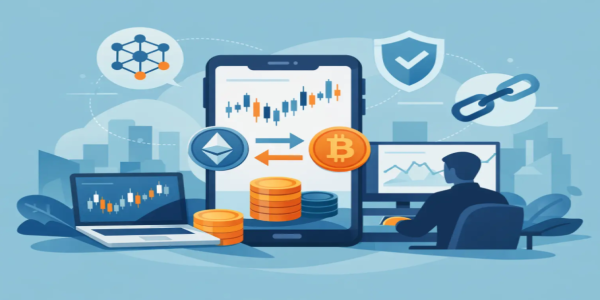
Decentralized Exchange Review for Independent Traders
Read this decentralized exchange review before trading. Compare wallet control, liquidity, fees, privacy, and execution speed with confidence upfront.
A trade can move before a traditional exchange finishes asking for another document. That gap is why decentralized trading appeals to independent crypto users: you want to act on an opportunity, move assets directly, and stay in control of your funds. But fast access only matters when the platform delivers reliable pricing, real liquidity, and a trading process you understand.
This decentralized exchange review focuses on the factors that matter when you want fewer barriers between intent and execution. The right platform should make crypto trading feel direct, not complicated. It should also make the trade-offs clear.
What a Decentralized Exchange Actually Changes
A decentralized exchange, often called a DEX, changes who controls the transaction process. Instead of depositing assets into a centralized platform that holds your balance, you may trade from a personal wallet through smart contracts or a peer-to-peer market. Depending on the platform design, you can retain more direct control over your crypto and avoid some of the account restrictions common on mainstream exchanges.
That distinction matters for traders who value privacy, mobility, and immediate market access. You are not waiting for an institution to decide when you can move your own assets. You can connect a wallet, review the available market, and take action when the opportunity appears.
Still, decentralization is not a magic label. Different exchanges use different models. Some are fully on-chain, where trades settle through smart contracts. Others combine decentralized trading features with platform-managed wallets, fiat conversion, or peer-to-peer services. The experience can be faster and more accessible, but your responsibility also increases.
Before you trade, understand where your assets sit, how orders are executed, and whether you control the private keys. Freedom works best when it comes with clear decisions.
Decentralized Exchange Review: What to Check First
The best decentralized exchange is not automatically the one with the loudest promise of low fees or anonymous access. It is the one that fits the way you trade. A casual buyer converting crypto to USD has different needs than an active trader watching spreads across multiple assets.
Wallet control and asset access
Start with custody. If you trade through a connected self-custody wallet, you hold the keys and approve transactions yourself. That reduces dependence on a third party, but it also means there is no password-reset desk if you lose your recovery phrase.
If a platform provides an integrated wallet, check how deposits, withdrawals, and internal transfers work. A good experience should make it easy to see your available balance, confirm an outgoing transaction, and understand whether there are network or platform withdrawal limits.
For independent traders, control is more than a slogan. It is the ability to move funds when you choose, without unnecessary friction.
Liquidity and execution quality
A clean interface means little if your order fills at a price far from the one you expected. Liquidity determines how easily an asset can be bought or sold without moving the market too much. Thin markets can create slippage, especially during sharp price moves or when trading lesser-known coins.
Look at the actual buy and sell prices, not just the last displayed price. Review the spread between them. If you plan to trade larger amounts, test with a smaller order first to see how execution behaves.
This is especially relevant for arbitrage-minded traders. A price difference is only useful if you can complete both sides of the trade quickly enough, account for fees, and move assets without delays that erase the opportunity.
Supported assets and conversion routes
More than 150 available cryptocurrencies can create more possibilities, but selection should be useful rather than decorative. Check whether the exchange supports the assets you actually hold, the pairs you want to trade, and reliable routes for converting between crypto and USD.
Broad coin access can matter when the market moves outside Bitcoin and Ethereum. It can also help traders who prefer to rotate between assets instead of cashing out after every position. However, newer or lower-volume tokens can have wider spreads and more volatile pricing. More choice requires more judgment.
Fees beyond the headline claim
Zero-commission language can be attractive, but every trader should understand the total cost of a transaction. Costs may appear as a trading fee, conversion spread, blockchain network fee, payment processing charge, or withdrawal fee. None of these are automatically unreasonable. The question is whether they are visible before you confirm.
A platform built for straightforward access should show you the amount you are sending, the amount you will receive, and any charges attached to the transaction. That transparency lets you compare routes and decide whether speed, price, or convenience matters most for that trade.
Privacy, access, and personal responsibility
Many crypto users are tired of lengthy onboarding flows and restrictive trading limits. A decentralized or privacy-focused platform can reduce those barriers, particularly for crypto-to-crypto transactions and wallet-based activity. This can be valuable when you want to trade without turning a simple transaction into a paperwork exercise.
At the same time, access requirements vary by service, payment method, and jurisdiction. Do not assume every product has identical rules. If you use a fiat on-ramp, peer-to-peer transfer, or card-based purchase, additional checks may apply depending on the payment partner and local requirements.
Privacy should never mean skipping basic security. Use a unique password where applicable, secure your wallet recovery phrase offline, confirm every transaction address, and be skeptical of anyone claiming they can recover funds or guarantee profits.
The Real Trade-Off: Convenience Versus Control
Traditional exchanges can feel restrictive because they place institutional processes between you and the market. Decentralized trading can remove much of that friction, but it shifts more responsibility to the user.
There may be no customer service team that can reverse a transaction sent to the wrong address. Smart contract interactions can carry technical risk. Price volatility does not disappear because the exchange is decentralized. And if you are trading peer-to-peer, you need to verify terms and follow the platform's safety process before releasing assets.
For many traders, that is not a reason to avoid decentralized access. It is a reason to trade with intention. Start with amounts you can afford to test. Learn the flow of deposits, swaps, order placement, and withdrawals. Keep records of transactions and fees. Once the process is familiar, you can move faster without moving blindly.
Who Benefits Most From Decentralized Trading?
Decentralized exchange access can be a strong fit for users who want to manage their own crypto, trade a wider range of assets, or avoid waiting through a drawn-out account approval process. It can also suit people who use peer-to-peer transfers, seek flexible crypto conversion, or look for market access beyond the narrow menus offered by larger platforms.
It is less suitable for anyone who expects every transaction to be reversible or wants an institution to make security decisions for them. If you prefer traditional account recovery, regulated brokerage-style support, and a fully managed custody experience, a mainstream exchange may feel more comfortable.
The right choice depends on your priorities. If independence, speed, and control lead the list, decentralized tools deserve serious attention. If you need hand-holding and transaction reversals, the lower-friction path may not be your best path.
A Better Way to Make Your First Trade
Do not begin by chasing the biggest percentage move on the screen. Begin with a clear purpose: buy an asset, convert an existing holding, test a wallet transfer, or compare a price across markets. Confirm the network, the receiving address, the quoted amount, and the final amount after fees before you approve anything.
Then evaluate the experience. Was the price clear? Did the trade execute as expected? Could you see the transaction status? Were you able to access your funds when you needed them? Those answers are more useful than promotional claims.
Budrigan Market is built for traders who want a more direct route into crypto markets, with broad asset access, wallet functionality, conversion options, and fewer unnecessary barriers. Whether you use one platform or compare several, keep the same standard: your trading venue should support your decisions, not slow them down.
Market access is an advantage only when you use it with discipline. Keep control of your keys, verify every detail, and let each trade serve a plan worth executing.
Share This Post
Recent Posts
-
7 Best Privacy Coins for Trading in 2026
04 Sep 2026
-
Peer-to-Peer Crypto Platform Review Checklist
04 Sep 2026
-
Why Use a Crypto Conversion Service for Trading?
31 Aug 2026
-
-

Fiat On Ramp Options for Faster Crypto Access
31 Aug 2026