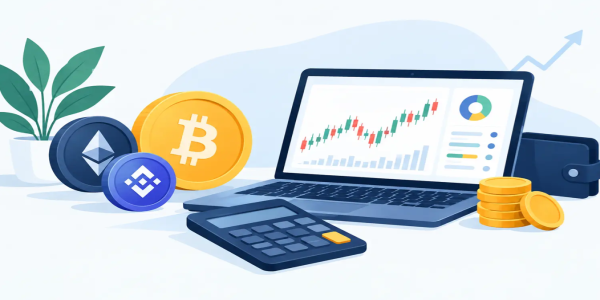
Guide to Trading Fee Calculations for Crypto
Use this guide to trading fee calculations to price spot, P2P, conversion, and network costs before you trade crypto with greater clarity and control.
A trade can be profitable on the chart and still lose money at execution. The difference is often hiding in the fee line, the spread, or the network cost required to move funds. This guide to trading fee calculations shows you how to see the full cost before you commit capital, so you can trade with more control and fewer surprises.
For active crypto users, fees are not just small print. They shape your break-even price, determine whether an arbitrage gap is real, and affect how much value reaches your wallet after a conversion or withdrawal. Fast access matters. Knowing the numbers matters just as much.
Start With the Total Cost of a Trade
The fee shown when you place an order is only one part of your trading cost. Your real cost is the amount you pay to enter, exit, convert, or transfer an asset.
For a basic spot purchase, use this formula:
Trading fee = trade value × fee rate
If you buy $2,000 of BTC and the fee rate is 0.20%, the calculation is:
$2,000 × 0.002 = $4
Your total purchase cost is $2,004 if the fee is charged separately in USD. If the platform deducts the fee from the asset you receive, you spend $2,000 but receive slightly less BTC. Both methods carry the same economic cost, but they change the balance you see in your wallet.
That is why you should always check three details before confirming an order: the fee rate, the currency in which the fee is charged, and whether the displayed quote already includes the charge.
A Practical Guide to Trading Fee Calculations
Crypto trading fees are commonly quoted as percentages, but a percentage alone does not tell the whole story. The calculation depends on the trade type and the way the platform prices the transaction.
Spot trading fees
Spot trading means exchanging one asset for another at the current market price. A platform may apply a single rate or use maker and taker pricing.
A maker adds an order to the order book, such as a limit buy placed below the current market. A taker matches an existing order immediately, as happens with most market orders. Taker fees can be higher because the trade uses available liquidity.
Suppose you sell 1 ETH at $3,000 and pay a 0.15% taker fee:
$3,000 × 0.0015 = $4.50
Your proceeds before any later withdrawal cost would be $2,995.50. If you later buy ETH again, you pay another fee on that second trade. Round trips matter because your position must overcome costs on both sides.
To find a simple round-trip trading cost, add the entry and exit fee rates. A 0.15% buy fee plus a 0.15% sell fee creates a 0.30% hurdle before spreads, price movement, and network costs. On a $5,000 position, that is $15 in trading fees alone.
Conversion fees and spreads
Crypto-to-crypto or crypto-to-USD conversion tools are built for speed. Instead of placing an order in a market, you accept a quoted exchange rate. The convenience is useful when you want immediate action, but the cost may appear as a stated conversion fee, a spread, or both.
The spread is the difference between the market reference price and the price available in your quote. For example, if BTC is trading near $60,000 and your instant conversion quote values it at $59,700 when you sell, the $300 difference is part of your execution cost.
Use this calculation to estimate the percentage impact:
Spread cost percentage = (reference price - quoted price) ÷ reference price × 100
In the example above:
($60,000 - $59,700) ÷ $60,000 × 100 = 0.50%
If the conversion also carries a 0.20% service fee, your approximate cost is 0.70%. The exact result depends on how the quote is structured, so read the confirmation screen rather than assuming a zero-commission message means a zero-cost transaction. A transaction can have no separate commission while still reflecting a market spread or third-party processing cost.
P2P transaction costs
Peer-to-peer trading can offer more payment flexibility and direct access to counterparties. The calculation changes because a P2P deal may involve platform charges, payment provider charges, and a price premium or discount set by the seller.
Imagine you want to purchase $500 worth of USDT. A seller offers a 2% premium above the market value, and your payment method charges 1.5%. Your estimated cost is:
Seller premium: $500 × 0.02 = $10
Payment cost: $500 × 0.015 = $7.50
Total added cost: $17.50
You would spend approximately $517.50 to receive $500 in USDT value, before any applicable platform fee. That may still be worthwhile if the payment option, speed, or availability solves a real problem. The point is to compare the total rather than focusing on one advertised number.
Network and withdrawal fees
Moving crypto to an external wallet introduces a different kind of charge: the blockchain network fee. This is not necessarily a trading fee. It pays for processing a transaction on the selected network, and it can change with network demand.
If you withdraw 0.05 ETH and the withdrawal charge is 0.001 ETH, the percentage cost is:
0.001 ÷ 0.05 × 100 = 2%
For a small withdrawal, that can be expensive. For a 2 ETH withdrawal, the same 0.001 ETH charge is only 0.05%. Fixed network fees reward planning. Fewer, larger transfers can be more efficient than repeated small withdrawals, provided that approach fits your own security and storage preferences.
Always verify the network before you send. Choosing a low-cost network can reduce fees, but only if the receiving wallet and destination service support that exact network. A cheaper transfer is not a better transfer if the assets cannot be recovered at the destination.
Calculate Your Break-Even Price Before You Trade
Break-even is the price your asset needs to reach before your trade covers all identifiable costs. It is one of the most useful numbers for short-term traders.
For a long spot position, a practical formula is:
Break-even sale value = total purchase cost ÷ (1 - sale fee rate)
Say you buy $1,000 of an asset and pay a 0.20% entry fee. Your purchase cost becomes $1,002. To sell with a 0.20% exit fee and break even:
$1,002 ÷ 0.998 = $1,004.01
Your position must rise by roughly 0.40%, before accounting for spread or slippage. If you entered using a market order during a fast move, slippage may push that hurdle higher.
Slippage is the difference between the price you expect and the average price you actually receive. It is most common with market orders, low-liquidity assets, and large orders relative to available market depth. A quoted fee can be low while execution is still costly because the order moves through multiple price levels.
Keep a Fee Record That Supports Better Decisions
You do not need a complicated system. For every trade, record the asset, trade value, price, explicit fee, quoted rate, network charge, and final amount received. Over a few weeks, patterns become obvious. You may find that small conversions are costing more than expected, that a particular payment method is expensive, or that frequent transfers are draining returns.
For arbitrage, calculate every leg before acting: the buy price, buy fee, transfer cost, expected transfer time, sell price, sell fee, and realistic slippage. A 1% price gap is not an opportunity if your combined costs are 1.2%. Markets can move before funds arrive, so leave room for execution risk instead of treating the visible spread as guaranteed profit.
Platforms may update fee schedules, liquidity conditions, and network charges. Check the live order preview or transaction confirmation each time, especially when trading a new asset, using a new payment route, or moving funds across chains.
Budrigan Market is built for traders who want direct access and fewer barriers between intent and execution. That freedom works best when you bring the same clarity to costs as you do to opportunity.
The next time a trade looks too good to miss, take 30 seconds to calculate the full path from funds in to funds out. That small habit can protect your capital better than any headline fee rate.
Share This Post
Recent Posts
-
7 Best Crypto Portfolio Trackers Compared
26 Nov 2026
-
7 Best Indicators for Range Trading Setups
26 Nov 2026
-

Spot Trading for Fast, Flexible Crypto Access
26 Nov 2026
-

DEX versus OTC desks: Which Fits Your Trade?
26 Nov 2026
-
Limit Orders Versus Market Orders Explained
18 Nov 2026