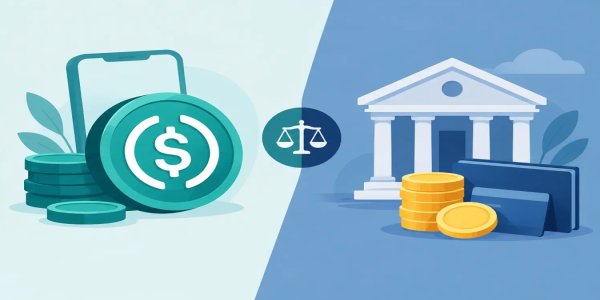
Stablecoins Versus Bank Deposits Compared
Stablecoins versus bank deposits: compare access, yield, risk, insurance, and control before deciding where to keep money ready for crypto trading now.
A dollar can sit in a bank account, or it can move through crypto markets in seconds. That is the real choice behind stablecoins versus bank deposits. One is built for familiar cash management and legal protections. The other is built for open, always-on digital markets. Neither automatically wins. The right place for your funds depends on whether your next move is paying bills, protecting a reserve, or acting on a trading opportunity before the market changes.
Stablecoins versus bank deposits: the core difference
A bank deposit is money held in an account at a financial institution. It is designed for day-to-day spending, direct deposits, bills, cash withdrawals, and saving. In the United States, qualifying deposits at an FDIC-insured bank are generally insured up to applicable limits if the bank fails. Credit unions can offer similar protection through the NCUA.
A stablecoin is a crypto asset designed to hold a stable value, most commonly one U.S. dollar per token. Dollar-pegged stablecoins can be transferred between compatible wallets, exchanged for crypto, used in peer-to-peer transactions, or moved across supported blockchain networks at any hour. They are digital settlement tools, not bank accounts.
That distinction matters. Holding $1,000 in a checking account means you have a claim on the bank deposit. Holding 1,000 units of a dollar stablecoin means you hold a token issued under that stablecoin's own structure, reserve policy, redemption terms, and blockchain rules. A stablecoin may track the dollar closely, but it is not the same thing as a federally insured deposit.
Access changes the equation
For traditional money management, bank deposits are difficult to beat. They connect directly to paychecks, debit cards, ACH transfers, checks, and many of the services that keep everyday life moving. If your priority is rent, utilities, groceries, or an emergency cash buffer, the predictable access of a bank account has real value.
Stablecoins offer a different kind of access: market access. Crypto markets do not close for weekends, holidays, or bank hours. A trader holding a supported stablecoin can often move from a dollar-pegged position into Bitcoin, Ethereum, or another digital asset without waiting for a wire transfer to clear. That can matter when volatility arrives outside banking hours.
For active traders, stablecoins are often the working capital of crypto. They allow a person to exit a volatile asset without fully leaving the crypto ecosystem, keep value ready for the next entry, and move funds between wallets or trading venues. The benefit is speed and flexibility. The trade-off is that every transfer, conversion, and network selection requires attention.
Safety is not one question
People often ask whether stablecoins are safer than bank deposits. The better question is: safer from what?
Bank deposits carry bank-specific risk, but insured accounts have a well-established protection framework within stated limits and eligibility rules. Banks can still impose transfer review, account restrictions, business-hour delays, and compliance checks. That can feel slow when you want to fund a fast-moving trade, but those systems are part of the traditional financial model.
Stablecoins remove some of that friction, yet introduce risks that do not exist in the same way with a standard deposit. A stablecoin can lose its peg. Its issuer can face reserve, redemption, legal, or operational pressure. A blockchain transaction can be sent to the wrong address and may not be recoverable. A self-custody wallet gives you direct control, but losing the recovery phrase can mean losing access permanently.
Not all stablecoins are structured alike. Some are backed by cash and short-term government securities, some use other collateral models, and some use mechanisms that may behave differently under stress. Before holding a stablecoin, look beyond the ticker. Review the issuer, reserve disclosures, redemption process, supported networks, and history of maintaining its peg. If you cannot explain how a stablecoin is intended to hold its value, it should not be a large part of your funds.
Control comes with responsibility
Bank deposits are convenient because a bank handles much of the infrastructure. It maintains the account system, provides statements, supports card payments, and may help with certain fraud claims or account recovery processes. You give up a degree of direct control in return for those services.
Stablecoins can put more control in your hands. With a private wallet, you can hold and move assets without relying on a traditional bank's operating hours. You can send value directly to another compatible wallet and use funds across a wider crypto market. For privacy-conscious users and people who value direct ownership, that independence is a major draw.
But direct ownership is not a free pass from responsibility. Verify every wallet address. Confirm the correct network before sending. Keep recovery information offline and secure. Be skeptical of unexpected messages, fake support accounts, and offers that promise guaranteed returns. In crypto, speed is valuable, but a rushed transaction can be expensive.
Yield can be misleading
A deposit account may pay interest, particularly a savings account, money market deposit account, or certificate of deposit. Rates vary, and access rules vary too. A CD may pay more than a basic checking account, for example, but it can limit access to funds for a set term.
Stablecoins do not automatically generate yield simply because they exist in your wallet. Any yield offer is a separate product with its own counterparty, lending, smart-contract, liquidity, and withdrawal risks. High advertised returns should lead to more questions, not less. Ask where the return comes from, who holds the assets, whether withdrawal terms can change, and what happens if the provider fails.
For many traders, the strongest use case for stablecoins is not chasing yield. It is preserving purchasing power inside the crypto market while keeping funds ready to move. That is a different goal from building a protected household savings reserve.
When a bank deposit makes more sense
Keep money in a bank deposit when you need reliable access for ordinary expenses, want the protections associated with an eligible insured account, or are holding funds you cannot afford to expose to crypto-specific risk. This is especially true for emergency savings, tax obligations, and money needed on a fixed date.
A bank deposit also makes sense if you do not want to manage wallet security, network fees, or redemption questions. There is no prize for forcing every dollar onto a blockchain. Financial freedom includes choosing the tool that creates the least friction for the job in front of you.
When stablecoins can make more sense
Stablecoins can fit when you actively trade crypto, need a dollar-based position available around the clock, or want to transfer value between supported digital-asset services without waiting for traditional rails. They can also be useful for peer-to-peer crypto activity when both parties understand the asset, network, and transaction finality involved.
The practical approach is to separate your money by purpose. Keep your everyday financial base where it serves you best. Keep only the amount of stablecoin capital you need for your planned trading, conversions, or transfers. That boundary can protect you from turning a useful trading tool into an oversized risk.
Build your own two-lane strategy
You do not have to choose one side forever. A bank account can handle the stable foundation: income, bills, savings, and spending. Stablecoins can handle the active lane: crypto purchases, position management, quick conversions, and transfers within the digital-asset economy.
Before moving funds, set a clear amount, choose an established stablecoin you understand, and test new wallet routes with a small transaction. Watch transaction fees and network congestion. Remember that a stablecoin's price target is one dollar, not a guarantee that every redemption, transfer, or platform conversion will happen instantly at exactly one dollar.
The opportunity is not in treating stablecoins as a replacement for every bank account. It is in using digital dollars with intention. When you are ready to trade, convert, or move capital at crypto speed, platforms such as Budrigan Market can help put your digital assets within reach. Keep your reserves protected, keep your trading capital deliberate, and let each dollar do the job you assigned it.
Share This Post
Recent Posts
-

Stablecoin Regulation Trends 2026 Explained
08 Oct 2026
-

Market Orders Versus Swaps: Know Your Trade
08 Oct 2026
-

Crypto Taxes: Trade Freely, Report Clearly
08 Oct 2026
-
9 Top Wallet Security Mistakes to Stop Now
08 Oct 2026
-

P2P Offer Comparison: Find Better Crypto Deals
06 Oct 2026