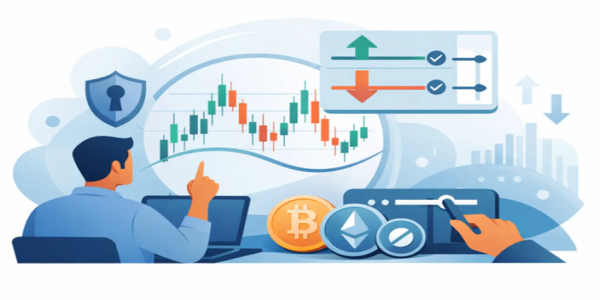
Crypto Limit Orders Give Traders More Control
Learn how crypto limit orders let you set your price, manage volatile entries and exits, and trade with more discipline instead of chasing moves daily.
A fast market can make a good trade look obvious for about five seconds. Then the price jumps, your target disappears, and a rushed market order fills far above or below where you planned. Crypto limit orders put the decision back in your hands: you choose the price first, then let the market come to you.
For traders who value speed without surrendering control, that difference matters. A limit order can help you pursue a better entry, protect a planned exit, and avoid making emotional decisions during sudden price swings.
What Is a Crypto Limit Order?
A limit order is an instruction to buy or sell a cryptocurrency only at a price you set or better. It does not guarantee an immediate trade. Instead, it waits in the order book until another trader is willing to take the other side at your chosen price.
If Bitcoin is trading at $65,000 and you want to buy only if it pulls back to $63,500, you can place a buy limit order at $63,500. The order will remain open until Bitcoin reaches that level and enough available liquidity can fill it, unless you cancel it or it expires under the platform's order settings.
The same logic applies when selling. If you hold ETH at $3,200 and want to take profit at $3,450, a sell limit order gives you a defined exit target without requiring you to watch every candle.
A buy limit order is placed below the current market price when you want a lower entry. A sell limit order is placed above the current market price when you want a higher exit. The key phrase is "or better." A buy order may fill below your limit price, while a sell order may fill above it, depending on available prices and market conditions.
Why Limit Orders Matter in Volatile Markets
Crypto trades around the clock. Prices can move sharply while you are working, sleeping, or simply away from the screen. Limit orders turn a trading plan into an active instruction instead of leaving it as a note you hope to remember.
They are especially useful when you have already identified a price level that makes sense to you. Maybe a coin has repeatedly found buyers near a support zone. Maybe you want to sell part of a position into a prior resistance area. Maybe you are converting assets and refuse to accept a poor rate caused by a temporary spike.
This is not about predicting every move perfectly. It is about setting terms before momentum and fear take over. Trading freedom means more than fast access to markets. It means deciding what price is acceptable before the market tests your discipline.
Limit order versus market order
A market order prioritizes execution. It buys or sells immediately at the best available prices in the order book. That can be useful when speed matters more than price, but the final fill may differ from the number you saw on screen, particularly in a fast-moving or thinly traded market.
A limit order prioritizes price. You define the maximum you will pay when buying or the minimum you will accept when selling. The trade-off is simple: your order may not fill at all.
Neither order type is automatically better. If you must enter or exit immediately, a market order may fit the moment. If your edge depends on a specific price, a limit order is usually the more disciplined choice.
How to Place Crypto Limit Orders With Purpose
The mechanics are straightforward, but the number you choose should come from a plan. Start by selecting the trading pair you want, such as BTC/USD or ETH/USDT. Choose the limit order option, then decide whether you are buying or selling.
Enter your limit price and the amount of crypto you want to trade. Before confirming, check the total value of the order, the available balance, and any applicable fee shown in the trade interface. Then submit the order and monitor its status in your open orders section.
On a streamlined exchange experience such as Budrigan Market, the goal is to move from decision to execution without unnecessary friction. But fast access should not mean careless execution. Take the extra moment to verify the price and quantity. A misplaced decimal can turn a smart idea into an expensive mistake.
Use levels, not random numbers
A limit price should have a reason behind it. Traders often use recent support and resistance levels, previous highs or lows, round-number price zones, or a price that fits their risk and reward plan.
For example, imagine SOL is trading at $150 after rising quickly from $135. Buying at $150 may still work, but perhaps you have decided that $143 offers a more attractive entry based on a recent consolidation area. A buy limit order at $143 lets you wait for your preferred opportunity rather than chase the current move.
The market may never return to $143. That is the cost of patience. But missing a trade is often less damaging than entering one at a price that no longer fits your plan.
Size the order for reality
Do not let a favorable price target trick you into using more capital than you can afford to risk. A limit order controls price, not outcome. After an order fills, the asset can continue moving against you.
Consider how much of your available funds belongs in one trade, how volatile the asset is, and what you will do if the setup fails. Many traders scale into a position with several smaller buy limits rather than committing everything at a single level. Others set multiple sell limits to take profit in stages as price rises.
That approach will not eliminate risk, but it can reduce the pressure to make one all-or-nothing decision.
What Can Prevent a Limit Order From Filling?
A limit order is not a promise that your trade will happen. Price must reach your target, and there must be enough matching demand or supply to execute your order. On actively traded pairs, fills are often more straightforward. On lower-volume assets, the order book can be thinner and price movement can be less predictable.
There is also a difference between a price touching your level and your entire order filling. If many orders are waiting at the same price ahead of yours, available liquidity may fill those first. Your order could be partially filled, leaving the remaining amount open.
Sharp moves can create another issue. Price may jump over a level so quickly that the available liquidity at your exact price is limited. This is one reason to check open orders after major market activity instead of assuming every target was completed.
Order duration matters, too. Some platforms allow orders to remain active until canceled, while others may apply expiration rules or offer different time-in-force settings. Know whether your order is still working before you build a new trade decision around it.
Common Mistakes That Cost Traders Opportunities
The biggest mistake is placing a limit order and forgetting it exists. An old buy order can fill weeks later after market conditions, news, or your own strategy have changed. Review open orders regularly and cancel anything that no longer reflects your view.
Another mistake is setting targets too close to the current price without accounting for normal volatility. If an asset routinely moves 3% in a day, a target just a few cents away may fill quickly but offer little strategic advantage. On the other hand, placing every order far from the market can leave you constantly waiting while opportunities pass.
Avoid treating a limit order like a stop-loss. A sell limit order above the market is designed to capture a higher price. It does not protect you if the price drops. Traders who need downside protection should understand the specific stop-order features available on their chosen platform and how those orders behave in volatile conditions.
Finally, do not confuse a filled order with a completed strategy. Entry is only one decision. Know your intended profit target, your acceptable loss, and the conditions that would make you reassess the trade.
Build Discipline Into Every Trade
Crypto limit orders are simple tools, but they reward clear thinking. They help you trade a price you chose instead of reacting to a price the market flashes at you. They also create room for a calmer process: identify the level, set the amount, confirm the order, and let the market show whether your opportunity arrives.
Use that control wisely. Choose prices with a reason, keep enough flexibility for changing conditions, and never place an order you would regret seeing filled while you are away from the screen. The strongest trade is often the one made on your terms.
Share This Post
Recent Posts
-

Stablecoin Regulation Trends 2026 Explained
08 Oct 2026
-

Market Orders Versus Swaps: Know Your Trade
08 Oct 2026
-

Stablecoins Versus Bank Deposits Compared
08 Oct 2026
-
Crypto Taxes: Trade Freely, Report Clearly
08 Oct 2026
-

9 Top Wallet Security Mistakes to Stop Now
08 Oct 2026