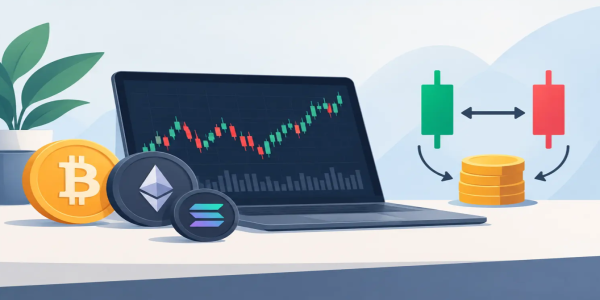
Crypto Spreads and Your Real Trading Cost
Crypto spreads can change your real trading cost. Learn how to read bid-ask gaps, compare markets, and trade with more control and confidence on demand.
A coin can appear to be moving in your favor while your trade is already starting at a loss. The reason is often crypto spreads - the gap between the price buyers will pay and the price sellers will accept. If you trade frequently, convert between assets, or look for fast opportunities across markets, that gap is not a minor detail. It is part of the price of getting in and getting out.
A trader focused only on the chart can miss the real cost of execution. The displayed market price may look attractive, but a wide spread can eat into a small move before the market has had time to work. Understanding spreads gives you a clearer view of every trade and more control over when you act.
What Crypto Spreads Actually Mean
Every active market has two sides. The bid is the highest price currently offered by a buyer. The ask is the lowest price currently requested by a seller. The difference between them is the spread.
If Bitcoin has a bid of $68,000 and an ask of $68,020, the spread is $20. A buyer entering at market will generally purchase near the ask. A seller exiting at market will generally sell near the bid. If the price does not move, the position begins with that $20 gap to overcome.
The dollar amount matters, but the percentage matters more when comparing different assets. A $0.02 spread on a low-priced token can be far more expensive relative to its value than a $20 spread on Bitcoin. A simple way to assess it is to divide the spread by the midpoint between the bid and ask, then multiply by 100.
For example, a token with a $9.90 bid and a $10.10 ask has a $0.20 spread. The midpoint is $10, making the spread roughly 2%. That is a meaningful hurdle for a short-term trade. The asset may need to move more than 2% before fees or other costs just to put the position near break-even.
Why Crypto Spreads Change So Fast
Spreads are not fixed platform charges. They reflect live market conditions, available liquidity, and how aggressively buyers and sellers are competing for an order. In a deep, active market, orders sit close together and spreads are usually tighter. In a thinner market, the next available buyer or seller may be much farther away.
Major assets often have more active participants, which can help create narrower spreads during normal conditions. Smaller-cap coins, newly trending tokens, and lightly traded pairs can behave differently. A price may look exciting on the screen, yet the distance between the bid and ask can signal that exiting quickly may be harder than entering.
Volatility also matters. When prices move sharply, market makers and individual traders may pull orders or price them more cautiously. The result can be a spread that expands in seconds. News events, large liquidations, sudden social-media momentum, and low-volume periods can all make execution more expensive.
That does not mean a wider spread automatically makes a trade bad. It means the trade needs a larger potential move, a longer time horizon, or more careful order placement. Opportunity and friction often show up together.
The Difference Between Spreads and Trading Fees
Fees are usually visible before or after a transaction. Spreads can be less obvious because they are built into the available buy and sell prices. Both affect your final result, but they work differently.
A trading fee is a stated charge based on trade size or order type. A spread is the market gap you cross when buying at the ask or selling at the bid. A platform can promote zero commission on a particular transaction and the market can still have a spread. Likewise, a market with a tight spread can still have a separate trading fee.
The real question is not which cost looks smaller in isolation. It is what you receive after execution compared with the price you expected. For a quick conversion, convenience and speed may justify a modest spread. For an arbitrage setup or short-term momentum trade, even a small spread can remove the edge.
Before placing an order, consider the full picture: the displayed bid and ask, any stated platform fee, the size of your order, and the likely price impact if the available liquidity is limited. That is your practical execution cost.
How to Read Crypto Spreads Before You Trade
Start by looking at both sides of the market, not just the last traded price. The last price tells you where one transaction happened. It does not guarantee where your next transaction will fill. If you are buying, focus on the ask. If you are selling, focus on the bid.
Next, compare the spread as a percentage. This keeps you from treating every dollar gap as equal. A 0.05% spread may be manageable for an active strategy. A 3% spread demands a much stronger reason to trade, especially if you expect to exit soon.
Then match your order type to your goal. A market order prioritizes speed. It can be useful when timing matters and the market is liquid, but it accepts the best available prices at that moment. A limit order prioritizes price control. You set the price you are willing to pay or accept, though there is no guarantee the order will fill.
For many traders, a limit order is a practical defense against an unexpectedly wide spread. Instead of chasing the ask during a fast move, you can place a price that fits your plan. The trade may not execute, but missing a trade is often less costly than entering at a price that leaves no room for profit.
Order size matters too. A small order may fill near the displayed ask or bid, while a larger order can consume several price levels. This is known as slippage. Spread is the gap visible at the top of the market; slippage is the additional cost that can appear when your order pushes deeper into available liquidity.
When Wider Spreads Can Still Make Sense
Not every trade needs the tightest possible spread. If you are converting crypto for a long-term position, the convenience of quick access may matter more than a small percentage difference. If you are moving funds between assets to manage risk, speed may be the priority.
The calculation changes for active traders. A scalper aiming for a fraction of a percent needs tight spreads and strong liquidity. An arbitrage trader must account for spreads on every leg of the transaction, not just the first purchase. A price difference between two markets is only useful if it remains after spreads, fees, transfer timing, and execution risk.
This is where discipline separates a visible price gap from a real opportunity. Do not calculate profit from headline prices alone. Calculate it from the price you can realistically buy at and the price you can realistically sell at.
Build a Better Spread-Aware Trading Routine
Check the bid and ask before every meaningful order, especially when trading less familiar assets. Watch how the gap behaves at different times rather than assuming the current quote is normal. If a spread suddenly widens, pause and ask what changed: volume, volatility, liquidity, or market sentiment.
Avoid forcing a trade because a chart looks ready to move. A good setup can become a poor execution if the spread is too wide for your target. Define your acceptable cost before you place the order, and use limit orders when price discipline matters more than immediate entry.
For traders who want fast access to a broad range of digital assets, Budrigan Market is built around reducing unnecessary friction between intent and execution. But trading freedom works best when it is paired with clear decisions. The faster you can recognize the true cost of a trade, the more confidently you can decide whether to take it, wait for better conditions, or move on to the next opportunity.
The market will always offer movement. Your advantage comes from knowing what that movement costs before you commit your capital.
Share This Post
Recent Posts
-
Market Volatility: Trade Fast, Not Blind
17 Nov 2026
-
Stop Losses: Trade Crypto With a Clear Exit Plan
17 Nov 2026
-
When to Use Limit Orders in Crypto Trading
17 Nov 2026
-
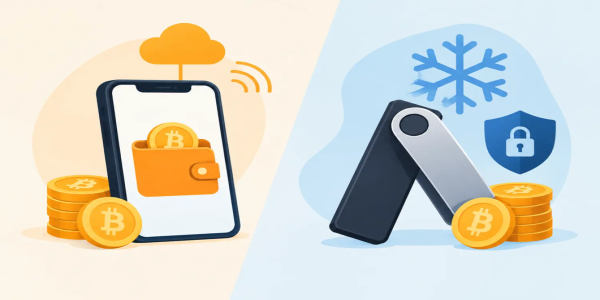
Hot Wallet Versus Cold Wallet for Your Crypto
17 Nov 2026
-
Crypto Dollar Cost Averaging Guide for Freedom
10 Nov 2026