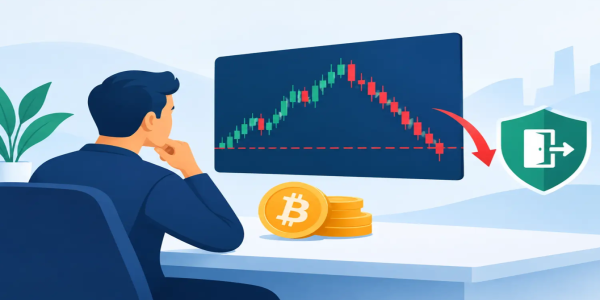
Stop Losses: Trade Crypto With a Clear Exit Plan
Learn how stop losses limit downside, protect crypto trading capital, and bring discipline to fast-moving markets without trading from panic or guesswork.
A crypto position can move against you before you have time to second-guess it. Stop losses give you a predefined exit when price reaches a level you have already decided is unacceptable. That is not fear. It is control.
Crypto markets trade around the clock, move fast, and can reverse without warning. If you want the freedom to act quickly, you also need rules that protect your capital when a trade does not work. A stop loss is one of the clearest rules a trader can use.
What Are Stop Losses?
A stop loss is an instruction designed to close a position after the market reaches a chosen price. For a spot trader who buys Bitcoin at $70,000, a stop loss at $67,900 may limit the loss if the market falls instead of continuing higher.
The core idea is simple: you choose your maximum acceptable loss before emotion enters the trade. Rather than watching every candle, hoping a losing position recovers, you establish an exit point and let your trading plan do its job.
Stop losses do not guarantee a precise exit price. During sharp volatility, the market may move through your stop level quickly, and an order can execute at a worse price than expected. This is known as slippage. Still, accepting a small, planned loss is often far better than holding through an open-ended decline.
Why Crypto Traders Use Stop Losses
The biggest benefit is capital preservation. Your trading balance is your opportunity. Once it is heavily damaged by one oversized loss, it becomes harder to recover and harder to make clear decisions.
Stop losses also reduce the pressure to react emotionally. Without one, a trader may keep moving the exit lower because selling feels like admitting defeat. The position becomes less about the original setup and more about hope. Hope is not a trading strategy.
For active traders, stops can create more freedom, not less. You can define a risk level, place your plan, and avoid being glued to a chart all day. That matters in a market that never closes.
There is a trade-off. A stop that is too close to the current price can be triggered by normal market noise, taking you out before the anticipated move happens. A stop that is too far away may expose too much of your balance. The goal is not to avoid every stopped-out trade. The goal is to keep any single loss manageable.
How to Set a Stop Loss That Makes Sense
A stop loss should come from the chart and your risk limit, not from a random percentage. Start by asking a direct question: at what price is my reason for entering this trade no longer valid?
If you bought a token because it held support near $2.00, a move below that support may invalidate the setup. Your stop could sit below that level, with enough room to account for ordinary price fluctuations. Placing it exactly at an obvious round number can be risky because many traders watch the same levels.
Then determine your position size. This is where many traders get it backward. They choose a large position first, then place a stop wherever it feels comfortable. A disciplined approach works in the opposite order:
- Decide how much of your total trading capital you are willing to lose on the trade.
- Identify the price level where the trade thesis is invalidated.
- Calculate a position size that keeps the potential loss within your limit.
For example, suppose you have $5,000 designated for trading and decide to risk 1% on a single trade. Your maximum planned loss is $50. If your entry is $10 and your stop is $9.50, your risk is $0.50 per coin. A $100 position, or 10 coins, would risk approximately $5 before fees and slippage. A 100-coin position would risk approximately $50.
The numbers are straightforward, but the discipline is the advantage. You are no longer asking, “How much can I make?” before asking, “What happens if I am wrong?”
Stop-Market vs. Stop-Limit Orders
The type of stop order matters, especially in volatile crypto markets.
A stop-market order is intended to become a market order once the stop price is reached. Its main advantage is execution: it prioritizes getting out. Its weakness is price uncertainty. If liquidity is thin or the market drops rapidly, the executed price can be below your trigger.
A stop-limit order triggers a limit order at a price you set. It gives you more control over the minimum price you are willing to accept, but it may not execute at all if price falls past the limit. You could remain in the position while the market continues lower.
Neither choice is automatically better. If your priority is leaving a position in a fast selloff, a stop-market structure may be more appropriate. If price control matters more and you understand the risk of non-execution, a stop-limit structure may fit your plan. Always confirm how the trading platform handles trigger prices, order activation, and available order types before relying on them.
Common Stop Loss Mistakes
The most common mistake is setting a stop based only on the amount you dislike losing. Markets do not care whether a 2% loss feels painful. Your stop needs a technical or strategic reason, such as a break below support, a failed breakout, or a level that invalidates your setup.
Another mistake is widening the stop after price starts falling. There are rare cases where a longer-term investor intentionally adjusts a plan because new information changes the thesis. But changing a stop simply to avoid taking a loss usually turns a controlled trade into an uncontrolled bet.
Traders also forget fees, spreads, and liquidity. A stop level is not the same as a guaranteed fill. On smaller coins, a modest order can affect price, and spreads can widen quickly. Keep your position size realistic for the asset’s trading activity.
Finally, do not use the same stop distance for every asset. Bitcoin, Ethereum, and a low-liquidity altcoin do not move the same way. A stop that works for a relatively stable major asset may be far too tight for a volatile newer token.
Using Trailing Stops to Protect a Winning Trade
A trailing stop moves upward as price rises, maintaining a selected distance below the market. If an asset climbs from $100 to $120 and your trailing distance is 10%, the stop can rise with the price rather than staying near the original entry.
This approach can help protect gains without choosing a fixed profit target too early. It is useful when momentum is strong and you want to give a winner room to run. But trailing stops can also be triggered during routine pullbacks, especially when the trail is too tight.
Consider the asset’s normal volatility before choosing a trailing percentage or dollar amount. A 3% trail may be practical for one market and nearly guaranteed to trigger in another. The best setting depends on your timeframe, the asset, and how much price movement your strategy expects.
Build the Exit Plan Before You Enter
A complete trade plan includes an entry, a stop loss, a target or exit condition, and a position size. Write those details down before placing the trade. If you cannot explain where you will exit when wrong, you may not have a trade setup yet.
Keep your risk small enough that a loss does not force you to chase the next opportunity. Crypto offers constant market access and more than enough setups. You do not need every trade. You need the ability to stay in the game when the next high-conviction opportunity appears.
Financial freedom is not built by refusing losses. It is built by deciding in advance which losses you can afford, honoring that decision, and keeping your capital ready for what comes next.
Share This Post
Recent Posts
-
Crypto Spreads and Your Real Trading Cost
17 Nov 2026
-

Market Volatility: Trade Fast, Not Blind
17 Nov 2026
-
When to Use Limit Orders in Crypto Trading
17 Nov 2026
-

Hot Wallet Versus Cold Wallet for Your Crypto
17 Nov 2026
-

Crypto Dollar Cost Averaging Guide for Freedom
10 Nov 2026