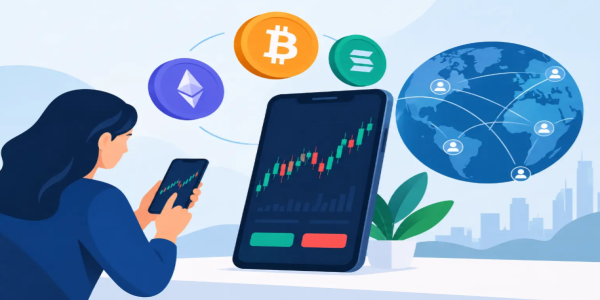
Crypto Trading Access Trends Reshaping Markets
Crypto trading access trends are pushing traders toward faster funding, broader asset choice, and platforms built for flexible, self-directed market action.
A price move can begin while a trader is still waiting for an account review, a deposit approval, or permission to access a market. That gap is why crypto trading access trends matter. The next phase of digital asset trading is not only about finding the next coin. It is about getting from intent to execution with fewer unnecessary barriers.
Retail traders increasingly expect the same thing from crypto that they expect from the internet: direct access, speed, choice, and control. They want to fund an account using the method that works for them, move between assets without a maze of steps, and act when a real opportunity appears. Platforms built around slow, institution-first workflows are feeling the pressure.
Crypto Trading Access Trends Are Moving Toward Choice
For years, access to crypto often meant accepting a narrow path. A trader opened an account, completed a lengthy process, waited for approval, connected a limited funding method, and then discovered that many assets or features were unavailable in their location. That model may suit a certain kind of investor. It does not suit everyone.
Today, traders are comparing platforms by how much practical choice they offer. That includes the range of digital assets, the availability of crypto-to-crypto swaps, the ability to convert crypto to USD, wallet access, and peer-to-peer options. A large token selection matters because markets do not move in a straight line. Capital often rotates from major assets into emerging sectors, smaller tokens, and short-term trading opportunities.
More choice does not mean every asset belongs in every portfolio. It means traders should have the ability to make that decision themselves. Access is valuable when it gives people room to build their own strategy instead of forcing them into a preselected menu.
The market is rewarding faster routes to action
Speed is becoming a baseline expectation. Traders want funding, conversion, and execution to feel connected rather than fragmented across several services. If buying an asset requires moving funds through multiple accounts and waiting through multiple checkpoints, the market may already have changed by the time the trade is possible.
That is especially relevant for active spot traders and arbitrage-minded users. Price differences between markets can appear and disappear quickly. Fast access does not guarantee a profitable trade, and it never replaces research or risk management. But unnecessary delay can remove the option to act at all.
The platforms gaining attention are reducing friction where they can: simpler interfaces, direct conversions, accessible wallets, and flexible routes for funding an account. The goal is straightforward. A trader should spend more time evaluating the market and less time fighting the mechanics of entry.
Privacy Expectations Are Changing
Crypto was built around the idea that users could hold and transfer value without relying entirely on traditional financial gatekeepers. That original promise remains powerful, particularly for users who are concerned about how much personal information is collected, stored, and shared.
Privacy-conscious trading is not about ignoring security. It is about recognizing that traders should be able to protect personal data while maintaining control of their assets and activity. Excessive data collection can create friction, expose users to additional risk if systems are compromised, and make digital finance feel less personal than the technology was designed to be.
As crypto trading access trends develop, platforms will be judged by how they balance access, account protection, and user autonomy. The strongest experience is not one that treats every customer like a compliance file. It is one that gives legitimate users a clear, efficient path to trade while providing practical tools for protecting their funds.
For users, that also means taking responsibility. Use strong, unique passwords. Secure recovery information. Review transaction details before confirming them. Privacy and independence work best when matched with disciplined personal security.
Funding Flexibility Is Part of Real Access
A trading account is only as useful as the trader's ability to fund it. This is why payment flexibility has become one of the most important competitive signals in the market. Bank-based funding may work well for some users, while others prefer to begin with existing crypto, use peer-to-peer transactions, or convert between assets already in their wallet.
There is no single best method. The right choice depends on timing, fees, availability, and a trader's personal preferences. What matters is avoiding a system where one funding option becomes a bottleneck for everyone.
Flexible funding also supports a more global market mindset. Crypto operates around the clock, and traders do not all operate on the same banking schedule. When market access depends on narrow payment windows, it feels out of step with an asset class that never closes.
Wallet access is becoming a core expectation
Users no longer want trading and storage to feel like completely separate jobs. They expect to be able to hold assets, monitor balances, convert when needed, and move funds with clarity. Wallet functionality is becoming part of the basic access equation because it puts visibility and control closer to the trader.
That does not eliminate the need for caution. Holding digital assets requires attention to security practices, transaction addresses, and the risks associated with volatile markets. Still, a practical wallet experience removes unnecessary handoffs and helps users stay connected to their positions.
Broad Asset Access Changes How Traders Think
Bitcoin and Ethereum remain central to the market, but they are not the entire market. Traders are looking beyond the largest names for exposure to new narratives, utility tokens, established altcoins, and market segments that may be moving before the headlines catch up.
Access to more than a handful of coins changes what is possible. It allows a trader to diversify their watchlist, convert gains into another asset without leaving the platform, or respond to a developing trend without opening multiple accounts elsewhere. It also makes it easier to build a strategy around personal conviction rather than platform limitations.
But broad access comes with a trade-off: more options can encourage impulsive decisions. Not every new token is a quality opportunity, and liquidity can vary sharply between assets. Smart traders check volume, pricing, project information, and their own exit plan before they commit funds. Freedom works better with a process.
The Interface Still Matters
A platform can offer hundreds of assets and multiple transaction types, but none of that helps if the experience is confusing. Beginner-to-intermediate traders do not need a screen crowded with features they will never use. They need a clear route to buy, sell, convert, fund, and review balances.
The best access trends are therefore not only technical. They are design trends. Clean navigation, visible pricing, straightforward transaction flows, and fewer dead ends make trading more approachable. This is not about making markets look risk-free. Crypto carries volatility, and users should see that clearly. It is about removing avoidable complexity from the tools themselves.
Budrigan Market reflects this shift by focusing on fast digital asset access, broad cryptocurrency availability, wallet utility, conversions, and peer-to-peer trading in one direct trading environment. For traders who value autonomy, the appeal is simple: less waiting, fewer detours, and more room to act on their own terms.
What Traders Should Look for Next
The future of access will be shaped by platforms that respect the trader's time. Expect continued demand for direct funding options, rapid conversions, wider asset availability, private account experiences, and tools that make it easier to move between trading and storage.
Still, access should be evaluated with clear eyes. Compare available markets, transaction costs, payment choices, wallet controls, security practices, and the ease of withdrawing or moving assets. A fast platform is useful only when the trader understands the terms, protects their account, and uses capital they can afford to risk.
The real opportunity is not merely having more buttons to press. It is having a clearer path from a market idea to a deliberate action. As access improves, traders who combine speed with patience, flexibility with security, and independence with sound judgment will be best positioned to make the most of what crypto offers.
Share This Post
Recent Posts
-
-

What Is Self Custody Crypto and Why It Matters
19 Sep 2026
-
How to Trade Altcoins Efficiently With a Plan
14 Sep 2026
-

A Guide to Decentralized Crypto Exchanges
14 Sep 2026
-
What the Future of No KYC Exchanges Looks Like
14 Sep 2026