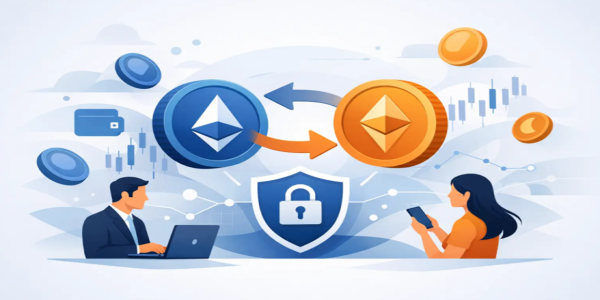
How to Swap Altcoins Safely Without Losing Control
Learn how to swap altcoins safely with smart wallet checks, price protection, and practical habits that keep every trade secure and in your control now.
A fast altcoin swap can feel like a win - until a copied token address, bad approval, or thin liquidity turns a simple trade into an expensive lesson. Knowing how to swap altcoins safely means keeping control before, during, and after the transaction. Speed matters in crypto, but protection matters more when your wallet is on the line.
Altcoins create opportunity because markets move quickly and new assets appear constantly. They also demand more attention than a basic buy or sell. The safest traders are not the slowest traders. They are the ones who verify what matters, set clear limits, and refuse to let urgency make decisions for them.
How to Swap Altcoins Safely Before You Trade
Start with the asset itself. A token name and ticker are not proof that you have found the real coin. Scam tokens often copy the branding of popular projects, use nearly identical tickers, and appear in wallet interfaces or search results beside legitimate assets. One wrong character in a contract address can send you into a worthless position.
Verify the official contract address using more than one reliable source, such as the project’s confirmed public channels and a trusted blockchain explorer. Then check that the token is on the network you intend to use. USDC on one network is not automatically the same tradable asset as USDC on another. Choosing the wrong chain can create delays, extra bridging costs, or loss if a platform does not support that deposit route.
Next, look at the market behind the quote. A token may show a tempting price, but the price is only useful if there is enough liquidity to exit your position. Thin pools can create major price impact, meaning your swap pushes the price against you. A small test swap is often the smarter move when you are using an unfamiliar pair, pool, or route.
Do not confuse a large token balance with real value. Check trading activity, liquidity depth, holder concentration, and whether the asset has a credible market across established venues. A chart can rise sharply while the ability to sell remains limited.
Secure the Wallet Before Connecting It
Your wallet is the control center for an altcoin swap. Treat every connection request as a decision with consequences. Use a wallet you control, protect its recovery phrase offline, and never type that phrase into a website, support chat, form, or browser prompt. Legitimate services do not need it to help you swap.
For higher-value holdings, separating funds is a practical defense. Keep long-term assets in a wallet that rarely connects to applications, and use a dedicated trading wallet for active swaps. This does not remove risk, but it limits the damage if a trading site, malicious signature, or browser extension compromises one wallet.
Before approving a connection, inspect the domain character by character. Fake sites frequently use misspellings, extra words, or lookalike letters to imitate known services. Do not enter a platform by clicking an unsolicited message, search ad, or direct message. Start from a saved, verified address instead.
Also review your browser extensions. A suspicious extension can monitor activity or interfere with transactions. Keep only extensions you recognize, update your wallet software, and lock your device when it is not in use. Privacy and freedom are meaningful only when your keys remain yours.
Read the Swap Details, Not Just the Expected Return
A swap screen can look simple: choose the asset you are selling, choose the asset you want, and confirm. The details behind that screen are where safe trading happens.
First, confirm the token pair, chain, and wallet address receiving the output. Then review the expected amount, minimum received amount, transaction fee, and price impact. If the minimum received amount is far below what you expect, pause. You may be accepting excessive slippage or trading through a poor route.
Slippage is the difference between the displayed quote and the price your order can actually receive when it executes. Low-liquidity tokens often need higher slippage settings, but high slippage also creates room for costly execution and certain scam mechanics. Set it only as high as the asset genuinely requires. If a trade needs an unusually high setting just to complete, that is a signal to investigate rather than force the transaction.
Network fees deserve attention as well. On congested networks, a small trade can become inefficient once fees are included. Consider whether the opportunity still makes sense after the swap fee, network fee, potential slippage, and any future cost to move or sell the asset. The headline gain is not the same as a real gain.
Watch for Approvals and Hidden Permissions
Many token swaps require an approval before the actual trade. An approval gives a smart contract permission to spend a specified token from your wallet. That can be normal, but the scope of that permission matters.
Avoid unlimited approvals when a limited amount is available and practical. Unlimited access may save a few clicks later, but it expands your exposure if the contract is exploited or malicious. For a token you will trade once, approving only the amount you intend to swap is usually the cleaner choice.
Read wallet prompts carefully. A transaction that sends tokens, grants token approval, signs a message, or changes account permissions is not the same action. If the wording is unclear, reject it and investigate before signing. No market move is worth approving a request you do not understand.
After trading, periodically review and revoke token approvals you no longer need. This is especially useful for experimental assets and applications you tried once. Good wallet hygiene is not glamorous, but it is one of the clearest ways to reduce unnecessary exposure.
Make Your First Swap a Controlled Test
When using a new platform, token, or network, do not make your first transaction your largest. Send or swap a small amount first. Confirm that the transaction settles as expected, the token arrives in your wallet, and you can view the correct balance on the intended network.
This approach is particularly valuable for cross-chain routes and newly listed altcoins. A test transaction costs a little time and sometimes an extra fee. That trade-off is usually far better than discovering a routing error after committing your full position.
Once the test is complete, check the transaction on a blockchain explorer. Confirm the destination address, received amount, gas paid, and contract interactions. Public transaction data gives you a record that is harder to misunderstand than a notification alone.
Stay Alert to Scams That Target Active Traders
The most convincing crypto scams do not always look like scams. They often arrive as urgent opportunities: an airdrop, a support warning, a guaranteed arbitrage trade, a private presale, or a message saying your wallet needs immediate verification. The goal is the same - get you to connect, sign, or send before you think.
Never send crypto to someone who promises to send more back. Never trust support agents who contact you first. Never install software or share your screen because a stranger says they can recover a transaction. Crypto transfers are generally irreversible, which makes independent verification essential.
Be equally cautious with tokens that appear in your wallet unexpectedly. These can be dusting or phishing attempts designed to make you visit a malicious site. Do not interact with unfamiliar tokens, follow links in their descriptions, or attempt to swap them just because they show a balance.
Trade With Freedom, Not Impulse
Fast access to more markets can be powerful, especially for traders who value autonomy and fewer barriers. Platforms such as Budrigan Market are built for users who want to move from intent to action without unnecessary friction. But open access does not replace personal discipline. It makes discipline more valuable.
Set a maximum amount for any new token, decide your acceptable loss before confirming a trade, and keep enough native network currency for future transactions. If you cannot afford to be wrong about a trade, the position is too large. This is true whether you are swapping a major altcoin or chasing a newly launched asset.
A safe swap is not about eliminating every risk. Crypto markets do not offer that promise. It is about controlling the risks you can control: the token address, the website, the permissions, the route, the price impact, and the size of your position.
The next time a market opportunity appears, take the extra minute. Verify the asset, read the approval, test the route, and confirm the final numbers. That minute protects the independence your wallet was built to give you.
Share This Post
Recent Posts
-
Why Crypto Prices Differ Across Exchanges
22 Oct 2026
-
Crypto Price Alerts That Help You Trade Faster
22 Oct 2026
-
Account Security Checklist for Crypto Traders
22 Oct 2026
-
Crypto Arbitrage Taxable? What U.S. Traders Owe
22 Oct 2026
-
Crypto Liquidity Assessment for Smarter Trades
22 Oct 2026