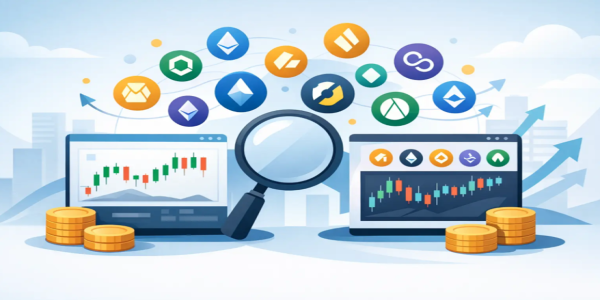
Which Exchange Supports More Altcoins Today?
Which exchange supports more altcoins? Compare listings, liquidity, access, custody, and trading freedom before choosing a market that fits your strategy.
The question, “which exchange supports more altcoins,” sounds simple until you look beyond the coin count. One platform may advertise thousands of assets but offer thin trading, delayed withdrawals, or limited access in your location. Another may list fewer coins yet give you faster execution, clearer markets, and a better path from funding to trade.
For traders who want more than the usual Bitcoin, Ethereum, and a handful of large-cap tokens, the right exchange is the one that combines selection with usable access. A long asset list has value only when you can actually buy, sell, convert, and move those assets on your terms.
Which Exchange Supports More Altcoins? Start With the Category
There is no permanent winner because listings change constantly. New tokens arrive, low-volume markets disappear, and regional rules affect what any centralized platform can offer. Instead of chasing a single name, compare the types of platforms that tend to offer the broadest altcoin access.
Large global centralized exchanges often have deep liquidity and polished trading tools. They usually support hundreds of assets, sometimes more, but the catalog available to a US-based user may be smaller than the full global list. They may also require identity verification, apply geographic restrictions, and limit certain funding methods or product features.
Altcoin-focused centralized exchanges usually move faster on emerging assets. These platforms can be a strong fit for traders looking for newer Layer 1 coins, DeFi tokens, gaming assets, AI-related tokens, and smaller-cap opportunities before they reach the largest venues. The trade-off is that lower-profile listings can have wider spreads, lighter order books, and higher volatility.
Decentralized exchanges can provide access to an even wider universe of tokens because anyone can create liquidity for a compatible asset. That freedom comes with a different responsibility. You need to verify the token contract, understand network fees, watch for fake copies, and assess whether enough liquidity exists to exit a position without major slippage.
A decentralized autonomous exchange model can sit between those experiences by prioritizing direct market access and fewer unnecessary barriers while keeping trading straightforward. The best fit depends on how much selection you need, how you fund your account, and whether your priority is early access, high liquidity, privacy, or simple conversions.
More Listings Do Not Always Mean More Opportunity
A platform claiming 1,000 or 5,000 listed tokens can attract attention. But a list is not the same thing as a market. Before choosing an exchange for altcoins, look at what happens after you click Buy.
First, check trading pairs. An altcoin might be listed only against one stablecoin or only against another cryptocurrency you do not hold. A useful exchange gives you practical routes into the assets you want, whether that means crypto-to-crypto swaps, crypto-to-USD conversions, or flexible funding options.
Next, look at liquidity. Liquidity determines how easily you can enter and exit a trade near the displayed price. A token can appear on a platform with an exciting chart and still be difficult to sell when momentum turns. For active traders and arbitrage-minded users, this matters more than the raw number of listed coins.
Then consider deposits and withdrawals. Some exchanges list an asset but temporarily pause transfers, support only one network, or impose high minimums. If you use wallets, peer-to-peer transactions, or multiple trading venues, you need to know whether the asset can move when you need it to move.
Finally, review the actual cost of access. A low headline trading fee can be offset by conversion spreads, withdrawal charges, network fees, or unfavorable execution on low-volume pairs. Trading freedom is not just about getting access to a ticker. It is about knowing the full path from funding to trade to withdrawal.
The Altcoin Categories Worth Checking
Rather than comparing exchanges by a giant alphabetical token list, compare them by the categories that match your strategy. A balanced altcoin selection should give you choices across established ecosystems and newer market themes.
Look for major smart-contract networks, scaling tokens, decentralized finance assets, exchange tokens, gaming and metaverse projects, infrastructure protocols, privacy-focused coins where permitted, stablecoins, and new narratives that are gaining traction. If a platform only carries the largest coins from each category, it may be convenient but not especially useful for traders seeking broader market exposure.
At the same time, do not treat “newly listed” as a quality signal. New tokens may offer momentum and opportunity, but they also carry elevated risk. Limited trading history, concentrated ownership, shallow liquidity, smart-contract weaknesses, and aggressive promotion can change a trade quickly.
The smarter approach is to build a watchlist before funding your account. Identify the coins you actually want to trade, check whether the exchange supports the correct network and pair, then compare execution conditions. This takes minutes and can prevent the frustration of opening an account only to find your target assets unavailable.
Access Matters as Much as Asset Selection
For many traders, the real obstacle is not finding an exchange with altcoins. It is getting through a slow onboarding process, dealing with restricted payment rails, or facing limits that interrupt a time-sensitive trade.
That is why an exchange should be measured by access as well as inventory. Can you create an account quickly? Can you fund it with the methods available to you? Can you convert between crypto and USD when your plan calls for it? Can you use a wallet and peer-to-peer options without adding unnecessary steps?
Budrigan Market offers access to more than 150 cryptocurrencies alongside spot trading, P2P transactions, wallet functionality, crypto conversion, and fiat on-ramp options. For users who value speed and fewer onboarding barriers, that combination can matter more than a bloated catalog of inactive markets.
However, access should never replace judgment. Before trading, understand the platform’s terms, available features in your jurisdiction, fee schedule, and the risks tied to the asset you are buying. Rules can vary by location, and token availability can change without much notice.
How to Compare Exchanges for Altcoin Trading
Use a simple decision process instead of relying on marketing claims. Start with your target list of five to 10 altcoins. If an exchange does not support most of them, there is no reason to make it your primary platform.
After that, inspect the markets themselves. Check recent volume, bid-ask spreads, supported pairs, and whether deposits and withdrawals are active. If you plan to trade smaller-cap assets, test with an amount you can afford to learn with before committing significant capital.
Also decide how you want to hold your crypto. Some traders prefer keeping funds ready on an exchange for quick execution. Others move long-term holdings to a self-custody wallet and send only trading capital to the platform. There is no one answer, but your exchange should support your operating style instead of forcing you into an inconvenient one.
Security deserves the same attention as selection. Protect your account with a unique password, strong authentication where available, and careful device habits. Never send funds to an address you have not verified, and be skeptical of token names that look nearly identical to popular projects. In altcoin markets, speed is valuable, but careless speed is expensive.
Choose the Exchange That Lets You Act
The exchange with the most altcoins on paper is not automatically the best place to trade. The better choice is the platform that supports the assets you care about, provides real liquidity, gives you workable funding and withdrawal options, and keeps friction from getting between your market view and your next move.
Build your watchlist, verify the markets, start with clear risk limits, and choose access that works for the way you trade. In a market that changes by the hour, the ability to act with confidence can be more valuable than an endless list of coins.
Share This Post
Recent Posts
-
Stablecoin Regulation Trends 2026 Explained
08 Oct 2026
-
Market Orders Versus Swaps: Know Your Trade
08 Oct 2026
-
Stablecoins Versus Bank Deposits Compared
08 Oct 2026
-
Crypto Taxes: Trade Freely, Report Clearly
08 Oct 2026
-
9 Top Wallet Security Mistakes to Stop Now
08 Oct 2026