Why Crypto Prices Differ Across Exchanges
Why crypto prices differ across exchanges: learn what drives spreads, liquidity gaps, fees, and timing so you can trade with more control and clarity.
Bitcoin is trading at one price on your screen, then you check another platform and see a different number. That gap can feel like an error, especially when markets are moving fast. But why crypto prices differ is not a mystery or a flaw in the market. It is a direct result of how crypto trading works: many independent venues, separate pools of buyers and sellers, different funding methods, and constantly changing demand.
For traders who value speed and flexibility, understanding those differences can turn confusion into a sharper view of opportunity. A quoted price is not a universal promise. It is the latest result of activity in a specific market at a specific moment.
There Is No Single Official Crypto Price
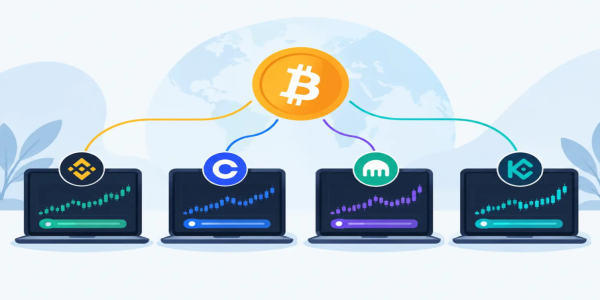
Unlike a stock listed on one primary exchange, most cryptocurrencies trade across many platforms around the clock. Each exchange maintains its own order book, which is simply the live list of buy orders and sell orders submitted by its users.
When a buyer accepts the lowest available sell order, that transaction may become the latest price shown on that exchange. On another venue, a different set of traders may be placing orders at slightly higher or lower levels. Both prices can be real at the same time.
Price-tracking websites often show an average drawn from multiple exchanges. That average is useful for a broad market reference, but it may not be the exact price you can buy or sell at when you place an order. The price that matters most is the executable price available in the market you are using, after the spread and any applicable fees.
Why Crypto Prices Differ From Platform to Platform
The size of the difference depends on the asset, the venue, and market conditions. For major coins during calm trading periods, gaps may be small. For newer tokens, thinly traded assets, or sudden market moves, the difference can widen quickly.
Liquidity changes the price you can actually get
Liquidity means how easily an asset can be bought or sold without moving its price much. A deep market has many active orders near the current price. A thin market has fewer orders, so even a modest purchase can consume the best available offers and push the next available price higher.
This is why the price displayed for a coin can be misleading if you plan to trade a larger amount. You may see a last trade at $1.00, but the next sellers may be asking $1.02, $1.05, and $1.10. Your average purchase price will depend on how much of the order book your trade reaches.
Liquidity is also not fixed. It can shift by the hour as traders move funds, react to news, or focus on different assets. A market that looks deep in the afternoon can become much thinner overnight.
Supply and demand are local before they are global
Crypto is global, but buying pressure still arrives in separate places. One platform may see a wave of buyers using a particular payment method. Another may have traders rushing to sell after a price move. These local bursts of demand can create temporary price gaps.
Fiat currency pairs add another layer. The price of BTC/USD can differ from BTC/USDT or BTC/USDC because the dollar-pegged asset itself can trade slightly above or below its intended value. Payment demand, redemption conditions, and confidence in a stablecoin can all influence that difference.
A platform serving a particular region may also reflect local demand. If users have fewer ways to access a coin, or a faster way to purchase it through one venue, they may be willing to pay a premium for immediate access.
Fees and funding routes affect market behavior
Moving money between platforms is not always instant or free. Traders consider network fees, withdrawal limits, deposit processing times, conversion costs, and the availability of their preferred payment method before they act.
Those frictions matter because they slow down arbitrage. Arbitrage is the practice of buying an asset where it is cheaper and selling it where it is more expensive. In theory, arbitrage should pull prices together. In practice, the trader has to move assets, cover costs, manage timing, and accept the risk that the gap disappears before the trade is complete.
If the difference is smaller than all related costs, it is not a profitable opportunity. It is just a difference on a screen.
Different products can create different quotes
Make sure you are comparing the same thing. Spot markets, perpetual futures, options, peer-to-peer offers, and instant conversion tools can all show different prices because they work differently.
A spot price is tied to buying or selling the actual asset. A futures price reflects expectations, leverage demand, funding conditions, and time-related factors. A peer-to-peer offer may include the seller's preferred payment method, settlement risk, or convenience premium. An instant conversion quote may build its spread into the rate offered to you.
None of these quotes are automatically wrong. They answer different trading needs. The key is knowing whether you are looking at a tradable spot order, a derivative contract, an advertised offer, or a conversion estimate.
The Spread Matters More Than the Headline Price
Many traders focus on the last traded price. The bid-ask spread often matters more.
The bid is the highest price someone is currently willing to pay. The ask is the lowest price someone is currently willing to accept. If the bid is $60,000 and the ask is $60,050, there is a $50 spread. If you buy immediately, you generally trade at or near the ask. If you sell immediately, you generally trade at or near the bid.
Wide spreads are common in low-liquidity markets and during volatility. They are also a signal to slow down. A dramatic price difference may be caused by a stale last trade while the current bid and ask tell a very different story.
Before acting, look beyond the headline number. Check the buy quote, sell quote, available depth, and the final amount you will receive or spend. This protects you from mistaking a visible price for an executable one.
Timing Can Create Gaps in Seconds
Crypto markets never close, and price information does not reach every platform at the exact same instant. During a major announcement or a sharp Bitcoin move, prices can jump multiple times in a few seconds. A chart on one exchange may refresh before another. A quoted conversion rate may update on a different schedule than a live order book.
This does not always mean one venue is lagging or unreliable. It may simply show how quickly the market is repricing risk. The faster the move, the more cautious you should be about chasing a quote you saw moments ago.
Limit orders can help in these moments. Instead of accepting the current market price, a limit order lets you set the maximum you will pay or the minimum you will accept. It may not fill, but it gives you more control over execution.
How to Use Price Differences Without Getting Trapped
Price differences can create opportunity, but they also attract impulsive decisions. A disciplined approach starts with verifying the full trade, not just the displayed number.
Compare like with like: the same asset, network, trading pair, order type, and trade size. Then calculate the complete cost. Include trading fees, spreads, conversion charges, withdrawal costs, network fees, and the time required to move funds if you plan to arbitrage.
Next, check liquidity at your intended size. A $20 test trade may look attractive, while a $2,000 order may produce enough slippage to erase the gap. Never assume the first price in the order book applies to the full amount you want to trade.
Finally, keep transfer risk in view. Blockchain confirmations can take time, wallets and networks must match exactly, and markets can move against you before assets arrive. Fast access is valuable, but speed should support a plan, not replace one.
For traders seeking direct access to a broad range of assets, Budrigan Market can be part of a flexible trading routine. Still, the same rule applies on every venue: know your quote, understand your costs, and choose the order type that matches your objective.
Price Gaps Are Information, Not Automatic Profit
A different price can reveal where demand is strongest, where liquidity is thin, or where traders are paying for convenience and speed. It can also reveal a market that deserves more caution. The widest gaps often appear when execution is hardest.
The trader with more control is not the one who reacts to every difference. It is the one who can identify the market, calculate the real cost, and act only when the trade still makes sense after the numbers are complete. Watch the spread, verify the depth, and let the price you can actually execute guide the decision.
Share This Post
Recent Posts
-

Crypto Price Alerts That Help You Trade Faster
22 Oct 2026
-

Account Security Checklist for Crypto Traders
22 Oct 2026
-

Crypto Arbitrage Taxable? What U.S. Traders Owe
22 Oct 2026
-

Crypto Liquidity Assessment for Smarter Trades
22 Oct 2026
-
Your Guide to Blockchain Transaction Fees
20 Oct 2026