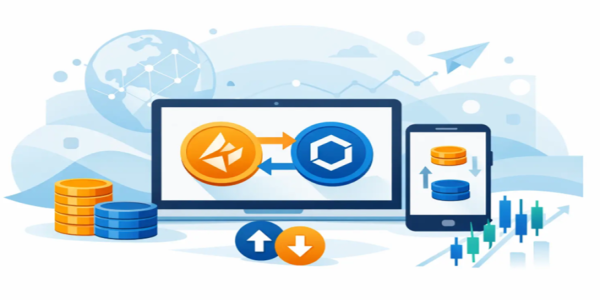
Crypto Conversion Guide for Faster, Flexible Trades
Use this crypto conversion guide to compare rates, manage timing, and move between digital assets and USD with greater clarity and control across markets.
A conversion can look simple on screen: choose the coin you own, choose the asset you want, confirm the amount. But every swap has a price. This crypto conversion guide shows how to make that price visible before you trade, whether you are moving from Bitcoin into stablecoins, rotating altcoins, or converting crypto to USD.
Fast access matters when markets move. So does control. The goal is not to chase every candle or convert at random. It is to understand what you are receiving, what the conversion costs, and whether the timing supports your next move.
What Crypto Conversion Actually Means
Crypto conversion is the exchange of one value for another. That may mean crypto-to-crypto, such as ETH to SOL, or crypto-to-fiat, such as USDC to USD. Unlike placing a limit order and waiting for a market to meet your price, a conversion tool typically gives you a quote and executes when you approve it.
That simplicity is useful for traders who want to reposition quickly. You may want to preserve gains by moving volatile assets into a stablecoin. You may need a different coin for a P2P transaction. Or you may see an opportunity in a market where holding the right base asset gives you more flexibility.
Still, a conversion is not automatically the best route in every situation. A direct trading pair can sometimes offer a better price, especially for active traders who know how to use order books. Conversion is often about speed and convenience. Spot trading can offer more price control. Choose based on the trade in front of you, not a one-size-fits-all rule.
Check the Quote Before You Confirm
The number that matters is not only the market price shown on a chart. It is the final amount you will receive after the platform applies its rate, spread, and any applicable fees.
A spread is the difference between the market price of an asset and the price available in a quick conversion quote. It is one way platforms cover execution and liquidity costs. A service may advertise low or zero commission on a specific transaction while the conversion rate still includes a spread. That does not make the conversion wrong. It means the final quote deserves your attention.
Before confirming, compare three details: the amount you are sending, the amount you will receive, and the quoted exchange rate. If the screen shows a rate expiry or countdown, that is a signal that the market is moving and the quote may refresh.
For smaller conversions, the difference may be minor. For a larger position, a small percentage can become meaningful. Convert in stages if you want to reduce the impact of a single fast market move, but remember that multiple conversions can also mean multiple spreads or fees. It depends on the asset, market conditions, and the platform’s pricing model.
Watch liquidity, especially beyond major coins
BTC, ETH, and leading stablecoins generally have deeper markets than smaller tokens. Deep liquidity can help keep a conversion close to the expected market rate. Thinly traded assets may have wider spreads, more price movement between quote and execution, or limited conversion routes.
If you are converting an emerging token, do not assume its displayed price tells the whole story. Check whether there is a direct pair available. If there is not, the platform may effectively route the conversion through another asset, such as USDT or BTC. That can add cost and exposure to price changes along the way.
Choose the Right Destination Asset
The asset you convert into should serve a clear purpose. Moving into another volatile coin because it is trending on social media is not a strategy. Moving because you have defined what you need from the next asset is different.
Stablecoins are often used when traders want to step out of market volatility without leaving the crypto economy. They can be useful for holding buying power, funding the next trade, or sending value across supported networks. However, stablecoins have their own considerations, including issuer structure, redemption mechanisms, network fees, and the risk that a token can trade away from its intended peg.
Converting to USD can make sense when you need spending liquidity or want to reduce exposure to crypto price swings. The availability, settlement method, and timing of a USD conversion depend on the platform and payment route. Check the exact details before treating a balance as immediately spendable cash.
For crypto-to-crypto conversions, think beyond price. Ask whether the destination asset has sufficient liquidity, whether you can use it on the network you need, and whether it fits your time horizon. A trader moving from BTC to ETH for a short-term market view has a different decision than a user converting USDC to a coin needed for a wallet transfer.
Timing Matters, but Perfection Is Not the Goal
Trying to call the exact top or bottom is how many traders turn a simple conversion into an emotional decision. A better approach is to define your trigger before the market accelerates.
You might decide to convert part of a position after reaching a profit target. You might use a stablecoin allocation to keep dry powder available during uncertainty. Or you might set a maximum loss level that tells you when preserving capital matters more than waiting for a reversal.
Partial conversions are especially useful when conviction is mixed. Instead of converting an entire position, you can shift a portion into a different asset and retain some exposure if the market keeps running. This does not remove risk, but it can reduce the pressure of making an all-or-nothing call.
Avoid converting during a panic simply because the chart is red. Volatility can create opportunity, but it can also make quotes change quickly. Take a moment to confirm the asset, network, amount, and final rate. Speed should support a decision, not replace one.
Your Crypto Conversion Guide for Safer Execution
A clean conversion process starts before you tap confirm. Keep your wallet addresses organized, know which network each asset uses, and protect account access with strong credentials and available security settings. Sending the right coin on the wrong network can turn a quick trade into a difficult recovery process.
When you use a platform such as Budrigan Market, review the available conversion path and final quote rather than relying on a headline price. Broad access to cryptocurrencies and quick account activation can create more opportunities to act, but the responsibility for each decision stays with the trader.
It also helps to keep records. Save the date, asset amounts, quoted rate, fees or spread information, and transaction ID for every significant conversion. These records can make portfolio tracking easier and may be needed for tax reporting. In the United States, converting one cryptocurrency into another can be a taxable disposition, even when no dollars reach your bank account. Tax rules can be fact-specific, so get qualified advice for your situation.
Build Conversion Into Your Trading Plan
The strongest conversions are usually planned, not improvised. Decide what percentage of your portfolio you are willing to keep in high-volatility assets, stablecoins, and cash-equivalent positions. Then use conversions to maintain that allocation as prices change.
For example, if one asset has grown into an outsized share of your holdings, converting a portion can rebalance your exposure. If you are preparing for a P2P payment or an arbitrage opportunity, holding a liquid asset ahead of time may be more useful than scrambling to convert after the window opens.
Do not confuse constant activity with progress. Every conversion should answer a practical question: Am I reducing risk, preparing capital, capturing a defined opportunity, or moving funds where they need to go? If the answer is unclear, waiting may be the more disciplined choice.
Financial freedom is not about making every trade. It is about having the access and confidence to make the right one when it counts. Start with a small conversion, read the final quote closely, and let each transaction sharpen your control over the market.
Share This Post
Recent Posts
-
Why Crypto Prices Differ Across Exchanges
22 Oct 2026
-

Crypto Price Alerts That Help You Trade Faster
22 Oct 2026
-

Account Security Checklist for Crypto Traders
22 Oct 2026
-
Crypto Arbitrage Taxable? What U.S. Traders Owe
22 Oct 2026
-
Crypto Liquidity Assessment for Smarter Trades
22 Oct 2026