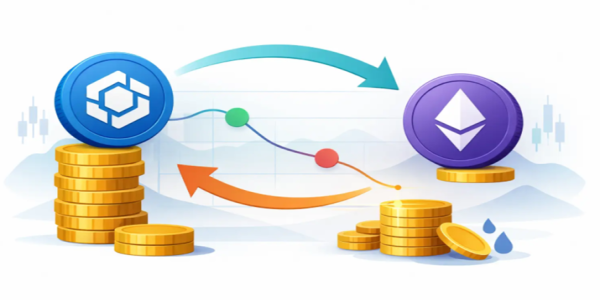
Token Swap Slippage Example: What You Actually Pay
A clear token swap slippage example shows how price movement changes your crypto trade, how to set tolerance, and when to wait, split, or adjust a swap now.
You see a quote for 1 ETH worth of tokens, press Swap, and receive less than the number shown a few seconds earlier. That is the reality behind a token swap slippage example. Slippage is not a mysterious fee and it is not always a platform error. It is the gap between the price you expected when you submitted a swap and the price the market could actually deliver when the transaction executed.
For traders who value fast, direct access to crypto markets, that difference matters. A small gap can be normal on a liquid pair. A large gap can turn a promising trade, conversion, or arbitrage setup into a bad entry. Knowing how to read it gives you more control before your assets move.
A Token Swap Slippage Example With Real Numbers
Assume ETH is trading near $3,000 and you want to swap 1 ETH into Token X. The quote on your screen says you should receive 3,000 Token X, meaning the implied price is $1 per token.
You set a slippage tolerance of 1%. That setting tells the swap to proceed only if you receive at least 2,970 Token X. It gives the transaction room to handle normal price movement or changes in available liquidity while it is waiting to execute.
Now imagine several buyers purchase Token X before your transaction is confirmed. Its effective price rises to $1.0067. Your 1 ETH can now buy roughly 2,980 Token X instead of 3,000. That 20-token difference is slippage, or about 0.67%.
Your transaction still completes because 2,980 is above your 2,970 minimum. But if the market moved further and the available output dropped to 2,960 Token X, the transaction should fail under a 1% tolerance. You would keep your 1 ETH, although you may still pay network costs depending on how the transaction was processed.
The key point is simple: the displayed quote is a snapshot, not a promise. Markets do not pause while a transaction travels through the network.
Price impact and slippage are related, but different
Traders often use these terms as if they mean the same thing. They do not.
Price impact is the movement your own order creates. On an automated market maker, a large purchase can consume a meaningful share of the token available in a liquidity pool. As you buy, the pool formula pushes the price higher. Even if nobody else trades, your order may receive a worse average price than the first unit quoted.
Slippage is the broader difference between the quoted result and your final result. It can include your price impact, other traders moving first, changing liquidity, and delays before confirmation.
This distinction becomes useful when you troubleshoot a poor result. If price impact is high before you submit the trade, your order itself is too large for the available liquidity. Waiting five minutes may not solve that. If price impact is low but final execution changes sharply, market activity or network conditions may be the larger issue.
Why Token Swap Slippage Changes So Fast
Slippage is usually lowest when a market is deep, active, and stable. Major assets with substantial liquidity often handle modest swaps with little difference between the quote and final output. Smaller tokens are another story. A single large order, social-media-driven volume spike, or liquidity withdrawal can change the available price quickly.
Network congestion also matters. A transaction that confirms in seconds has less time for market conditions to change than one that sits pending for several minutes. Faster confirmation does not remove risk, but it narrows the window where the quote can become stale.
Volatility is the third major force. During a sudden BTC or ETH move, connected token pairs can reprice rapidly. A tolerance that worked during a quiet afternoon may be too tight during a major market breakout, or too loose when liquidity is thin and the market is unstable.
There is no universal setting that works for every token. The right tolerance depends on the pair, order size, current volatility, liquidity depth, and how urgently you need the trade executed.
How to Set a Slippage Tolerance Without Guessing
A low tolerance protects your price, but it increases the chance that the transaction will fail. A high tolerance makes execution more likely, but it lets the swap accept a worse result. The goal is not to set the highest number possible. The goal is to set the smallest number that makes sense for the market you are trading.
For a liquid, established pair in normal conditions, a narrow tolerance can be reasonable. For a thinly traded token or a fast-moving market, the same setting may cause repeated failed swaps. Repeatedly resubmitting a transaction can waste time and network fees while the price keeps moving away.
Before confirming, look at the minimum amount received, not only the estimated amount. The estimated amount is the best current quote. The minimum received is the real boundary you have authorized. If that minimum would make the trade unprofitable or materially change your plan, do not approve it.
A practical approach is to begin conservatively and adjust only when you understand why the swap is failing. Do not raise tolerance simply because a transaction did not go through. First check whether the market moved, liquidity is shallow, or your trade size is creating too much price impact.
A quick break-even check
Suppose you plan to swap $1,000 of ETH into Token X because you expect Token X to rise 2%. If the swap has 1.2% price impact, potential slippage up to 1%, and network costs, your expected upside may already be gone before you enter the position.
This is especially relevant for arbitrage-minded traders. A price difference between two venues is not automatically profit. The trade must clear every cost: the buy-side price impact, slippage, network charges, conversion costs, transfer time, and the possibility that the second market reprices before you sell.
Fast access helps you act when an opportunity appears, but speed should support discipline, not replace it.
Four Ways to Reduce Slippage Before You Swap
Reduce the order size. Splitting one large swap into smaller transactions can lower price impact on a shallow pool. The trade-off is that you may pay network costs more than once, and the market can move between swaps.
Choose more liquid routes. A direct Token A to Token B route is not always the best route. In some cases, routing through a highly liquid asset such as ETH or a stablecoin produces a better final output, even with an extra step.
Avoid chasing sudden pumps. When a chart moves almost vertically, quotes can expire quickly and liquidity can disappear without warning. A larger tolerance may fill the order, but it can also lock in a far worse entry than you intended.
Review the transaction preview. Check the quoted output, minimum received, price impact, route, and network cost. These numbers tell you whether the trade still matches the decision you made before opening the swap screen.
The cleanest trade is not always the trade that executes fastest. Sometimes the better move is to wait for liquidity, use a smaller amount, or skip a setup whose costs are too high.
Common Mistakes That Make Slippage More Expensive
The first mistake is treating slippage tolerance as a recommendation rather than a limit. If you enter 5%, you are giving the transaction permission to execute up to 5% below the quoted output. That may be acceptable for a highly volatile asset when execution is critical, but it should be a deliberate decision.
The second is ignoring token taxes or transfer mechanics. Some tokens charge fees when bought, sold, or transferred. Those fees can reduce what reaches your wallet and may look like slippage even though they come from the token’s own rules. Read the transaction details and understand the asset before trading it.
The third is approving unfamiliar contracts without checking the basic facts. A token can have low liquidity, restrictive sell conditions, or deceptive trading behavior. No slippage setting can fix a token that cannot be sold normally. If the market structure looks unclear, keep your size small or walk away.
Budrigan Market is built for traders who want direct market access without unnecessary friction, but control still starts with the trader. Know the amount you are sending, the minimum you are willing to receive, and the costs that stand between a quote and a completed position.
When a Failed Swap Is Actually a Win
A failed swap can feel frustrating, especially when the market is moving. Yet a failure caused by your slippage limit often means the protection worked. The price moved beyond the outcome you approved, and the transaction stopped rather than filling at a result you did not want.
Instead of immediately increasing the tolerance, reopen the quote and reassess the setup. Is the token still worth buying at the new price? Has the expected profit disappeared? Is liquidity deteriorating? A trade that only works with a very wide tolerance is often telling you something useful about the risk.
The strongest habit is to decide your acceptable outcome before you press Swap. A clear limit turns slippage from an unpleasant surprise into a controlled part of trading - and leaves you free to wait for the next opportunity when the numbers are back in your favor.
Share This Post
Recent Posts
-

Stablecoin Regulation Trends 2026 Explained
08 Oct 2026
-

Market Orders Versus Swaps: Know Your Trade
08 Oct 2026
-

Stablecoins Versus Bank Deposits Compared
08 Oct 2026
-
Crypto Taxes: Trade Freely, Report Clearly
08 Oct 2026
-
9 Top Wallet Security Mistakes to Stop Now
08 Oct 2026