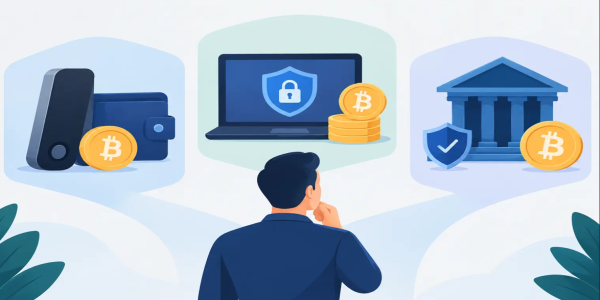
Custody Model Comparison for Crypto Traders
This custody model comparison explains how self-custody, exchange custody, and shared control shape crypto security, access, speed, and risk for traders.
A trade can take seconds. Regaining access to crypto can take much longer - or become impossible. That is why a custody model comparison matters before you fund a wallet, move coins to an exchange, or commit capital to a strategy. The real question is simple: who controls the private keys, and what does that control cost you in convenience, security, and freedom?
Crypto was built around direct ownership. Yet many traders choose platforms to get faster execution, simple conversions, P2P access, and a cleaner path from cash to digital assets. There is no single custody setup that wins every time. The right choice depends on whether you prioritize immediate trading, independent control, recovery options, or protection from operational mistakes.
What Crypto Custody Really Means
Custody is the arrangement that determines who holds the private keys required to move crypto. A wallet balance may look like money sitting in an account, but the keys are what authorize transactions on the blockchain. Control the keys and you control the assets. Hand that control to a provider and you gain services, but you also take on provider risk.
For active traders, custody affects more than storage. It can determine how quickly you can enter a volatile market, whether withdrawals require extra checks, how easily you can recover from a lost password, and whether your assets are exposed if a third party has a security or liquidity failure.
The three main approaches are self-custody, third-party custody, and shared or hybrid custody. Each comes with a different trade-off between independence and convenience.
Custody Model Comparison: The Three Main Choices
Self-custody: maximum personal control
With self-custody, you hold your own private keys or recovery phrase. This can mean a hardware wallet kept offline, a software wallet on a phone, or another wallet where only you can approve a transaction.
The advantage is direct control. You do not need a platform to authorize a withdrawal, and your funds are not dependent on a company staying operational. For holders who want to move assets freely, participate in on-chain services, or keep long-term reserves outside an exchange, self-custody is the clearest expression of crypto ownership.
The cost is responsibility. Lose the recovery phrase, expose it to someone else, sign a malicious transaction, or send funds to the wrong address, and there may be no support team that can reverse the result. Self-custody is powerful, but it is not passive. It requires careful backups, device security, and the discipline to verify every transaction.
Third-party custody: speed and trading access
Third-party custody means a platform controls the keys while showing your balance in an account. This is the familiar model used by many centralized exchanges and trading services. It is often the fastest route to buying, converting, and trading crypto because your funds are already inside the platform environment.
For a trader reacting to price movement, that convenience matters. You can move from USD to crypto, swap between assets, or place orders without waiting for on-chain confirmations between every action. Account recovery can also be easier if you lose a password or change devices.
But convenience is not the same as direct ownership. Your access depends on the platform's systems, withdrawal policies, security practices, and operating condition. A provider can experience outages, impose limits, or become a target for attackers. Before placing meaningful balances with any service, understand how it stores assets, what withdrawal controls apply, and what happens if access is interrupted.
Shared or hybrid custody: control with guardrails
Shared custody sits between the two. Depending on the setup, transactions may require approval from more than one key, or a user and service may each control part of the authorization process. Multisignature wallets and certain managed wallet arrangements fall into this category.
This model can reduce the danger of one compromised key while avoiding a total handoff to a third party. It may suit teams, families, businesses, or traders who want an additional recovery path without giving up every layer of control.
The trade-off is complexity. More keys, more approvals, and more recovery rules can create friction exactly when you want to move quickly. Hybrid custody works best when the setup is clear before an emergency, not when users are trying to understand it during a market crash.
The Decision Is About Your Trading Behavior
Choosing custody is not a philosophy test. It is an operational decision. A long-term holder and an active arbitrage trader do not need the same arrangement.
If your priority is frequent conversions and immediate market access, keeping a working balance on a trading platform can be practical. It reduces transfer delays and lets you act when an opportunity appears. This is especially relevant for users moving between multiple cryptocurrencies, pursuing short-term price gaps, or using P2P transactions where timing affects the result.
If your priority is long-term control, moving assets not needed for current trades into a self-custody wallet may make more sense. This separates your trading capital from your reserve holdings. It also limits the amount exposed to a single platform account.
Many experienced users choose a split approach: keep active funds where trading happens and keep longer-term holdings in self-custody. That is not a guarantee against risk. It is simply a way to avoid making one custody model carry every job.
Security Is More Than Where Coins Sit
A wallet can be self-custodied and still be unsafe if the recovery phrase is stored in a screenshot, cloud note, or unprotected email. A custodial account can be well managed but still vulnerable if the user reuses passwords or ignores account security settings.
Your real security posture comes from habits. Use a unique password, turn on the strongest available account protection, and treat recovery phrases like the keys to a vault. Never share them with support agents, social media contacts, or anyone claiming they can recover lost funds. Legitimate services do not need your private recovery phrase.
Also consider transaction risk. Crypto transfers are generally irreversible. Confirm the asset, network, recipient address, and amount before sending. A low-friction platform can make trading faster, but speed should never replace verification when you are withdrawing or transferring funds.
Questions to Ask Before You Deposit
Before choosing any custody arrangement, get direct answers. Who controls the private keys? Can you withdraw to an external wallet? Are there withdrawal limits, review periods, or supported-network restrictions? What account recovery process applies? Does the provider separate customer assets from operating funds? What security controls can you activate yourself?
For self-custody, ask a different set of questions: Where will the recovery phrase be stored? Who can access it if something happens to you? Have you tested the wallet and backup process with a small amount first? Can you recognize phishing attempts and unsafe signing requests?
These questions are not designed to slow you down. They prevent avoidable mistakes from turning a fast trade into a permanent loss.
Build a Setup That Matches Your Freedom
Crypto gives you choices that traditional finance often does not. You can hold keys directly, use a platform for easier market access, or divide funds across both. The opportunity is real, but so is the responsibility to choose intentionally.
For traders who want immediate access without turning every action into an administrative process, a platform wallet can keep capital ready to move. Budrigan Market is built around fast access to digital asset trading, conversions, and wallet functionality for users who value fewer barriers between a decision and execution. Still, only keep the amount you need for your current activity in any trading environment.
The smartest custody decision is rarely the most extreme one. Choose the model that fits your next move, protect your keys and accounts, and keep control of your crypto strategy on your terms.
Share This Post
Recent Posts
-

P2P Offer Comparison: Find Better Crypto Deals
06 Oct 2026
-

Stablecoin Merchant Payment Example: A Real Sale
06 Oct 2026
-

Binary Trading: Know the Risk Before You Trade
06 Oct 2026
-

Account Funding Options for Faster Crypto Trades
06 Oct 2026
-

What Makes Peer Payments Private and Secure?
23 Sep 2026