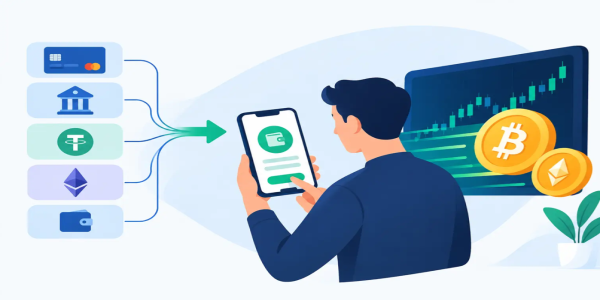
Account Funding Options for Faster Crypto Trades
Compare account funding options for crypto trading, including wallet transfers, P2P deals, and fiat on-ramps, with a focus on speed, cost, and control.
Markets do not wait for a bank to open. The right account funding options can determine whether you act on a price move, miss it, or pay more than necessary just to get capital into position. For traders who value speed, privacy, and control, funding is not an afterthought. It is part of the trading strategy.
Your best method depends on what you already hold, how quickly you need to trade, the payment methods available to you, and the level of control you want over the process. A wallet transfer may be ideal for someone already holding crypto. A peer-to-peer deal may offer more flexibility. A fiat on-ramp can be the direct route for someone entering the market with dollars.
Account Funding Options That Match Your Trading Style
There is no single funding path that wins in every situation. The strongest setup is the one that gets your funds where they need to be with acceptable cost, timing, and risk.
Fund with a crypto wallet transfer
If you already own digital assets, transferring crypto from an external wallet is often the most direct way to fund a trading account. You send supported assets to the deposit address for the correct network, wait for blockchain confirmations, and trade once the balance becomes available.
This route is built for independence. You are moving assets you already control rather than relying on a bank, card issuer, or payment processor to approve a transaction. It can also make sense when you want to convert one asset into another, access a broader range of markets, or move capital quickly between trading opportunities.
The trade-off is precision. A wrong network, unsupported token, or incorrect address can create serious problems. Always verify the asset, network, and destination address before confirming a transfer. Start with a small test amount when using a new wallet or network, especially if the amount matters to your trading plan.
Network fees and confirmation times also change. A transfer that is inexpensive during quiet market conditions can cost more when blockchain activity rises. Fast is valuable, but confirm the full cost before you move funds.
Use peer-to-peer funding for payment flexibility
Peer-to-peer funding connects buyers and sellers directly. Instead of depending on one centralized payment rail, you can transact with another market participant using a mutually accepted payment method and agreed terms.
This can be a powerful choice when conventional funding methods feel restrictive or when you want more flexibility in how you buy crypto. P2P markets can support a broader range of local and digital payment preferences than a single card or bank option. They also give experienced users room to compare offers rather than accepting one fixed rate.
Freedom works best with discipline. Review the counterparty's transaction history when available, read the terms carefully, and keep communication and payment records clear. Do not send a payment outside the agreed process or release assets based on a screenshot alone. The deal is only as strong as the checks you make before confirming it.
For opportunistic traders, P2P can be useful when speed and payment choice matter more than a fully standardized checkout experience. For beginners, it is worth taking the time to understand each step before using it for a larger purchase.
Buy crypto through a fiat on-ramp
A fiat on-ramp lets you use dollars or another supported government-issued currency to purchase crypto. Depending on availability, this may include cards, bank-based methods, or other payment options presented during the funding process.
For first-time buyers, this is usually the clearest entry point. You begin with money you already use every day, choose the crypto you want to acquire, and move into the market without first sourcing assets elsewhere. It is a practical route when your goal is to build a starting position, convert cash into a stablecoin, or react to an opportunity without transferring crypto from another platform.
Convenience has a price, and it is not always obvious at first glance. Check the quoted exchange rate, processing fee, payment fee, and any limits before you approve a purchase. A low advertised fee does not automatically mean the best overall value if the conversion rate is less favorable.
Payment availability can vary by provider, location, payment type, and transaction amount. If a method is unavailable, that does not mean you are blocked from the market. It may simply mean another funding route better fits your situation.
Convert crypto already in your account
Funding does not always mean bringing in new money. If your account already holds crypto, conversion can put capital to work without waiting for an external transfer or payment authorization.
A trader holding Bitcoin, for example, may convert part of that balance into a stablecoin before entering a different market. Someone holding a stablecoin may convert into an altcoin when a setup appears. This approach keeps value inside the crypto economy and can reduce the number of steps between decision and execution.
The key question is exposure. Converting one volatile asset into another changes your market position, while converting into a stablecoin may reduce price volatility but introduces different considerations, including the asset's issuer and market liquidity. Know what you are exchanging and why before you tap confirm.
How to Choose Between Account Funding Options
Start with timing. If you already have crypto in a self-custody wallet, an on-chain transfer may be the fastest practical choice. If you only hold dollars, a fiat on-ramp or P2P purchase may be more realistic. If the money is already inside your account as another asset, conversion may be immediate.
Then look at the total cost. Do not focus on one number. Compare network fees, payment charges, exchange rates, spreads, and the price of waiting. A cheaper method that takes days can be more expensive than a slightly higher-cost route if it causes you to miss the trade you wanted to take.
Finally, consider control. Some traders prefer the familiar structure of card or bank-funded purchases. Others want the flexibility of P2P transactions or the self-directed nature of wallet-to-wallet transfers. The right answer depends on your experience, your payment access, and how much responsibility you are prepared to take for each step.
Fund With Purpose, Not Just Speed
Before depositing, decide what the funds are for. Are you buying and holding a major asset? Building a stablecoin balance for future trades? Looking for a short-term conversion? Moving funds for P2P activity? A clear purpose helps you select the right asset, funding method, and amount.
Avoid sending your entire available balance into a trade because a chart looks exciting. Crypto markets can move sharply in either direction, and funding speed should never replace risk management. Keep records of transfers, confirm addresses carefully, and use security practices that protect access to your wallet and account.
Budrigan Market is built for traders who want fewer barriers between intent and execution, with access to crypto transfers, conversions, P2P activity, and fiat entry points in one trading environment. The opportunity is in having choices. The advantage comes from knowing which choice fits the moment.
Choose a funding method you understand, verify every detail before funds move, and keep enough flexibility to act when the next market opportunity appears.
Share This Post
Recent Posts
-

P2P Offer Comparison: Find Better Crypto Deals
06 Oct 2026
-

Stablecoin Merchant Payment Example: A Real Sale
06 Oct 2026
-
Binary Trading: Know the Risk Before You Trade
06 Oct 2026
-
Custody Model Comparison for Crypto Traders
06 Oct 2026
-
What Makes Peer Payments Private and Secure?
23 Sep 2026