Decentralized Exchange Order Book Guide
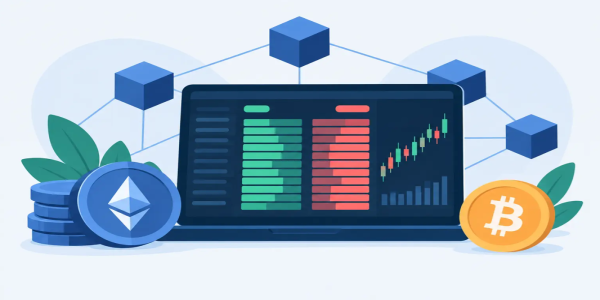
This decentralized exchange order book guide shows how bids, asks, spreads, and execution work so you can trade crypto with greater control and confidence.
A decentralized exchange order book guide starts with a simple reality: the price you see is not always the price you get. When you place a trade, your result depends on the live bids and asks waiting in the market, the size of your order, and how quickly liquidity can meet it.
For traders who want more control than a basic swap screen provides, an order book puts the market in view. You can set your own price, see available liquidity, and decide whether to take an immediate trade or wait for the market to come to you. That control matters when every percentage point counts.
What Is a Decentralized Exchange Order Book?
An order book is a real-time record of open buy and sell orders for a trading pair, such as BTC/USD or ETH/USDT. On one side are bids - prices buyers are willing to pay. On the other are asks - prices sellers are willing to accept.
A decentralized exchange, or DEX, applies this familiar market structure to crypto trading without relying on the same centralized custody model used by traditional platforms. Depending on the protocol, orders may be recorded and matched on-chain, off-chain with on-chain settlement, or through a hybrid design. The details differ, but the goal is the same: let participants trade directly through transparent market rules.
Unlike an automated market maker, where a pool and formula determine the quoted price, an order book shows individual trading interest. You are not simply accepting a pool price. You are interacting with a market made up of other traders' orders.
The Four Numbers That Shape Every Trade
Before placing an order, focus on four pieces of information: the best bid, the best ask, the spread, and the available depth.
The best bid is the highest active price someone will pay. The best ask is the lowest active price someone will sell for. If Bitcoin has a best bid of $60,000 and a best ask of $60,020, the spread is $20.
A narrow spread usually signals a more active market. A wide spread can mean fewer participants, lower liquidity, or more uncertainty around fair value. Neither automatically makes a market good or bad, but wide spreads deserve more caution when you need fast execution.
Market depth shows how much crypto is available at each price level. A book might show a small amount of ETH for sale at $3,000, then much larger amounts at $3,020 and $3,050. If you try to buy more than is available at the lowest ask, your order may fill across several higher prices. That difference between the expected price and the average price you actually receive is called slippage.
Reading the Bid Side
The bid side tells you where demand is sitting. Larger bid sizes can act as visible buying interest, but they are not guarantees. Traders can cancel open orders before they are filled, and a large bid can disappear when the market moves.
Use bids as information, not certainty. Look for several levels of demand rather than placing your entire decision on one oversized order.
Reading the Ask Side
The ask side shows the supply waiting above the current market. If there are heavy asks clustered at a certain level, price may slow down there as buyers absorb that supply. But just like bids, asks can be changed or canceled at any time.
The order book is a live negotiation, not a prediction machine. It gives you a clearer view of current intent, not a promise of the next candle.
Market Orders vs. Limit Orders
Your order type determines whether you prioritize speed or price control.
A market order is built for immediate execution. If you place a market buy, you accept the best available asks until your requested amount is filled. This can be useful when the market is moving quickly or when entering the position matters more than hitting one exact price.
The trade-off is slippage. In a thin market, a market order can consume multiple levels of the book and produce an average fill far from the price you first saw. Always check depth before sending a large market order.
A limit order lets you choose the price you are willing to accept. For example, if ETH is trading near $3,000 but you only want to buy at $2,950, you can place a limit buy at $2,950 and wait. Your order will remain open until it is filled, canceled, or expires according to the exchange's settings.
Limit orders put price discipline first, but they do not guarantee execution. The market may never reach your chosen price. Or it may touch that price briefly without filling your full size because other orders were ahead of you in the queue.
For active traders, the practical choice often depends on urgency. Use market orders when immediate entry or exit is worth the potential price impact. Use limit orders when you have a target and do not want to chase the market.
How Matching and Settlement Work on a DEX
When a buy order and sell order meet at the same price, the exchange matches them. The matching process usually follows price priority first: better prices are filled before worse prices. At the same price, many order-book systems also use time priority, meaning earlier orders are generally filled before newer ones.
The decentralized part matters after and around that match. Some DEXs keep every stage on-chain, creating a highly transparent record but potentially adding network costs and slower updates. Others use off-chain order matching to keep the interface responsive, then settle completed trades through smart contracts. Hybrid models can offer speed, but they require you to understand where matching occurs and how settlement is enforced.
This is not a minor technical detail. It affects trading fees, confirmation times, cancellation behavior, and your exposure to network congestion. If the chain is busy, an on-chain action may cost more or take longer than expected. Plan for those conditions instead of treating every market like it operates at the same speed.
A Smarter Way to Place Your First Order
Start by selecting a pair with meaningful activity. A screen full of prices does not guarantee that you can trade a larger amount efficiently. Check the spread and scan several levels of depth before choosing your size.
Next, decide the outcome you actually need. If your goal is to buy a specific coin only below a certain price, use a limit order. If your priority is closing risk during a fast move, a market order may be more appropriate, but reduce your size or break it into smaller trades if the book is thin.
Then review the full cost. The displayed price is only part of the equation. Factor in trading fees, network fees where applicable, the spread, and potential slippage. A zero-commission message on one transaction type does not mean every trading action has zero cost. Read the order preview before confirming.
Finally, verify the order status. An open limit order is not a completed trade. Watch whether it is partially filled, fully filled, or still waiting. If market conditions have changed, canceling or adjusting an unfilled order may be better than leaving it forgotten in the book.
Common Mistakes That Cost Traders
The most expensive mistake is treating the last traded price as a guaranteed execution price. The last price only tells you where a recent transaction occurred. Your trade fills against the orders available now.
Another common error is using a large market order in a low-liquidity pair. A trader may see a favorable quote, submit a sizable buy, and discover that the average fill is much higher because the order swept through multiple asks. Splitting the order or using limits can provide more control.
It is also easy to confuse an order book with a safety guarantee. Decentralized trading can reduce certain intermediaries, but it introduces its own responsibilities. Confirm the correct token, protect wallet access, review smart-contract and network risks, and be cautious with unfamiliar markets. Freedom works best when paired with deliberate decisions.
Order Books Give You a Clearer Trading Edge
An order book does not tell you where crypto prices will go next. What it does give you is something more useful than a blind swap: visibility. You can see current demand, supply, price gaps, and the liquidity available for your trade before committing funds.
For traders who value direct access and fewer barriers between an idea and an order, that visibility can change how decisions are made. Budrigan Market supports the kind of active crypto experience where speed and choice matter, but your strongest advantage still comes from understanding the mechanics behind every click.
Keep your first trades measured. Read the spread, respect liquidity, choose the order type that fits your goal, and let the market come to your price when patience is the better trade.
Share This Post
Recent Posts
-

What Makes Peer Payments Private and Secure?
23 Sep 2026
-

Best Order Types for Beginners to Trade Smart
23 Sep 2026
-

Peer Payment Dispute Resolution Guide for Crypto
23 Sep 2026
-
Stablecoin Conversion Steps for Faster Trading
23 Sep 2026
-