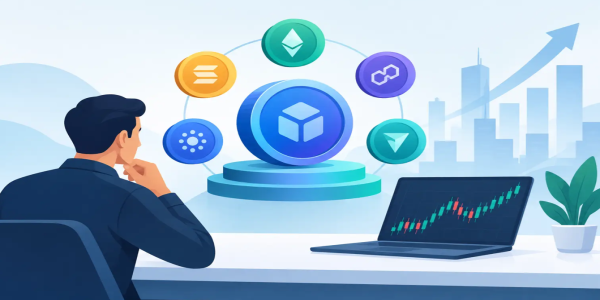
Tokenization Trends 2026: What Traders Can Use
Tokenization trends 2026 are reshaping crypto markets. See how tokenized assets, stablecoins, and onchain settlement may change trading access in 2026.
A token can now represent far more than a native crypto asset. It can represent cash, a Treasury bill, a fund share, gold in storage, a private credit position, or access to a real-world service. That shift is why tokenization trends 2026 matter to everyday traders, not only banks and fund managers. The next phase of crypto market growth may come from bringing familiar value onchain - where it can move faster, trade more flexibly, and settle around the clock.
For traders who value direct access and fewer barriers, tokenization creates a bigger question: which assets will actually become liquid, useful, and worth watching? Hype alone does not create a market. Issuance quality, redemption rights, liquidity, custody, and trading access do.
Tokenization Trends 2026 Are Moving Beyond the Narrative
Tokenization has been discussed for years, but 2026 is likely to be less about proving the technology and more about proving the market structure. A tokenized asset needs more than a blockchain wrapper. It needs a credible issuer, clear legal ownership, reliable pricing, and a way for holders to redeem or transfer value when they need to.
The winners will not necessarily be the most complicated products. They will be the assets people already understand and want to hold: cash-like instruments, government debt, commodities, broad market funds, and selected credit products. These products have recognizable value, which makes them easier to price and easier for traders to evaluate.
That does not mean every token labeled "real-world asset" deserves attention. Some tokens provide direct legal claims on underlying assets. Others only track a price, depend on a centralized platform, or restrict transfers. The difference matters. Before trading, know what the token represents and what rights come with it.
Tokenized Treasuries Could Keep Growing
Tokenized Treasury products have become one of the clearest use cases for real-world assets onchain. They offer exposure to short-term government debt through a format that can be held and transferred using blockchain infrastructure.
Their appeal is straightforward. When traders want to reduce crypto exposure without fully exiting the digital asset economy, a yield-bearing cash alternative can be more attractive than idle balances. It can also give platforms, decentralized finance protocols, and market participants a collateral option tied to a familiar asset class.
Still, this market has trade-offs. Access may depend on where a user lives, who issued the product, and whether the token can be redeemed directly. Some products have transfer restrictions or limited secondary-market liquidity. A tokenized Treasury is not automatically equivalent to holding Treasury securities in a traditional brokerage account.
For active traders, the opportunity is less about chasing a new ticker and more about capital efficiency. In volatile periods, tokenized cash products may become part of how traders rotate between risk assets and defensive positions without leaving onchain markets entirely.
Stablecoins Will Compete on Utility, Not Just Size
Stablecoins remain central to tokenization because they are already the most widely used tokenized form of money in crypto. In 2026, the competition is likely to become more intense. Traders will look beyond a coin's market cap and ask harder questions: Can it hold its peg under pressure? Is it easy to redeem? Which chains support it? Does it have deep liquidity where I trade?
Expect more separation between stablecoins built for payments, stablecoins built for trading liquidity, and products designed to share yield or collateral income. Each serves a different purpose. A payment-focused stablecoin may prioritize speed and low transaction costs. A trading stablecoin needs strong liquidity across markets. A yield-oriented product may introduce additional issuer, smart contract, or regulatory complexity.
The practical takeaway is simple: do not treat all dollar-pegged tokens as identical. Check the reserve model, redemption process, chain availability, and market depth before using one as your main trading base.
Tokenized Funds May Expand Market Access
Traditional funds have long been difficult to move, settle, and access outside standard market hours. Tokenized funds could change part of that experience by making fund interests available through blockchain-based records and transfers.
The potential is significant. Investors may gain access to fractional exposure, faster settlement, and easier movement between tokenized cash and tokenized investment products. For crypto-native traders, this could create a more direct bridge between digital asset markets and conventional financial exposure.
But access is not the same as liquidity. A tokenized fund may still have subscription windows, redemption limits, eligibility rules, management fees, or limited trading venues. Twenty-four-hour transfer capability does not guarantee twenty-four-hour pricing or instant exits at fair value.
This is where disciplined traders have an edge. Read the terms. Look for how net asset value is calculated, whether secondary trading is available, and what happens when markets move quickly. The asset behind the token remains the foundation of its value.
More Assets Onchain Means More Fragmented Liquidity
One challenge behind the biggest tokenization trends in 2026 will be fragmentation. The same type of asset may exist across multiple blockchains, issuers, and platforms. Liquidity can become scattered, even when demand is real.
Interoperability tools and cross-chain settlement may reduce this friction, but they also add risk. Bridges, wrapped assets, and third-party routing systems introduce additional technical and counterparty considerations. Fast movement between chains is useful only if the route is secure and the destination market has real liquidity.
For traders, this creates an advantage for those who track where volume actually happens. A token may look impressive on paper but trade with wide spreads or low depth. Before entering a position, check the available market pairs, order-book activity, transfer costs, and exit route.
Settlement Speed Can Change Trading Strategy
Traditional finance often operates on delayed settlement cycles. Tokenized assets can move toward near-instant settlement, which has major implications for collateral, arbitrage, and risk management.
Faster settlement may allow capital to be redeployed more quickly after a sale. It can reduce the time between trade execution and final transfer. It may also create more opportunities for price differences across venues, especially as tokenized versions of familiar assets begin trading alongside crypto markets.
Yet speed is not always an advantage if the market lacks safeguards. Instant settlement means errors can become final quickly. It also means traders need to manage wallet security, address verification, and transaction fees with more care. Freedom comes with responsibility - especially when there is no bank desk to reverse a mistaken transfer.
What to Watch Before Trading Tokenized Assets
The strongest opportunities will be built on transparency, not branding. Before you buy, trade, or use a tokenized asset as collateral, focus on four core questions:
- What underlying asset or legal claim does the token represent?
- Who issues, holds, audits, and redeems the asset?
- Where can the token be traded, transferred, or converted?
- How quickly can you exit if market conditions change?
Also consider whether the product fits your purpose. A tokenized gold product may be useful for diversification, but not for rapid arbitrage if liquidity is thin. A yield-bearing dollar token may be attractive for parked capital, but not if its transfer rules limit your trading flexibility. The best choice depends on your strategy, time horizon, and tolerance for issuer risk.
A More Open Market Needs Smarter Traders
Tokenization is pushing crypto toward a broader financial marketplace where digital assets, cash-like instruments, and real-world value can exist side by side. That could give retail traders more choice than the old system of separate brokers, banks, and exchanges ever offered.
Platforms built around fast crypto access, such as Budrigan Market, are positioned for users who want to move when opportunity appears rather than wait through unnecessary friction. But speed should support better decisions, not replace them. Keep control of your wallet security, understand each asset before you trade it, and never confuse a token's name with its actual value.
The market will reward traders who stay curious enough to spot the shift and selective enough to avoid every shiny new listing. Watch where real liquidity, clear redemption, and usable access come together. That is where tokenization becomes more than a trend.
Share This Post
Recent Posts
-

-

-
-
-

Practical Guide to Investor Risk Tolerance
07 Nov 2026