Why Do Crypto Spreads Widen When Markets Move?
Why do crypto spreads widen during volatility, low liquidity, and sudden demand? Learn what drives execution costs and how to trade with more control.
A coin can show one price on the chart and a very different price when you press Buy or Sell. That gap is the spread, and understanding why do crypto spreads widen can help you avoid paying more than you expected for a trade. It is not always a platform problem. Often, it is the market showing you its true cost of immediate access.
For traders who value speed and freedom, spreads matter because they affect the price you actually receive. A narrow spread can make entry and exit feel efficient. A wide one can turn a quick trade, conversion, or arbitrage idea into a less favorable execution. The key is knowing what causes the gap before the market moves against you.
What a Crypto Spread Really Means
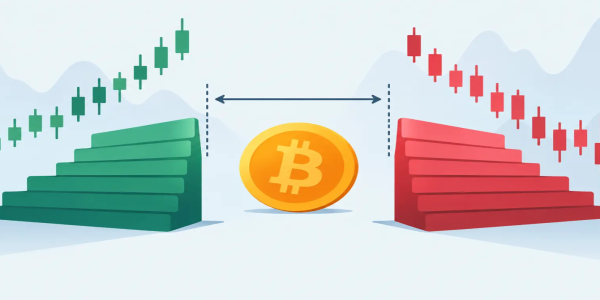
The spread is the difference between the highest available buy price and the lowest available sell price at a given moment. The lowest price a seller will accept is the ask. The highest price a buyer will pay is the bid.
If Bitcoin has a best bid of $90,000 and a best ask of $90,030, the spread is $30. If you buy instantly, you generally trade at the ask. If you sell instantly, you generally trade at the bid. That difference is part of the cost of trading immediately rather than waiting for another trader to meet your price.
Spreads are not the same as a displayed trading fee. A platform may show a low or zero commission on a particular transaction, while the available market price still contains a spread. Both matter when you compare your expected price with your completed trade.
Why Do Crypto Spreads Widen?
Crypto spreads widen when the balance between buyers, sellers, and available liquidity becomes less stable. In plain terms, there are fewer participants willing to take the other side of your trade at nearby prices.
Volatility changes prices faster than orders can refill
A sudden Bitcoin move, a major exchange headline, a liquidation wave, or a regulatory announcement can shift market expectations in seconds. Market makers and active traders may pull orders that are no longer priced safely. They do not want to sell at a price that could be far too low moments later, or buy at a price that could collapse before they can manage the risk.
As those nearby orders disappear, the gap between bids and asks expands. This is why a spread may look normal during a quiet session and widen sharply when the market begins moving fast. The spread is, in part, a price for uncertainty.
Low liquidity leaves fewer prices available
Liquidity refers to how easily an asset can be bought or sold without significantly moving its price. Bitcoin, Ethereum, and widely traded stablecoins usually have more active participants than smaller or newer tokens. More participants often means more standing buy and sell orders near the current market price.
A lower-volume asset may have only a thin line of orders on either side of the market. One moderate purchase can consume the closest asks and force the next buyer to accept a higher price. One sizable sale can do the same to bids. The spread widens because the market is not deep enough to absorb interest smoothly.
This does not mean every smaller asset is a bad opportunity. It means the trade-off for accessing emerging or less common coins can be a higher spread and more execution risk.
Large orders can consume the order book
Your order size matters. A $100 trade may fill near the best quoted price, while a $20,000 order in the same asset may reach several price levels before it is complete. This is known as slippage.
Spreads and slippage often appear together, but they are different. The spread is the gap at the top of the market. Slippage is the additional price movement caused by your order consuming available liquidity. When both are elevated, an instant market order can cost more than a trader expects.
Liquidity is fragmented across crypto markets
Crypto does not trade in one central marketplace. Prices and order depth are distributed across exchanges, P2P venues, trading pairs, and regions. A coin can be highly liquid in one market and relatively thin in another, especially when it is paired with a less frequently used asset or payment method.
Arbitrage traders work to close these differences, but they need time, capital, transfer access, and enough price advantage to cover costs and risk. During fast conditions, the gap can remain open longer than expected. What looks like an easy opportunity can disappear before funds settle or the trade completes.
Market makers need room for risk
Market makers help create tradable markets by continuously offering bids and asks. Their profit opportunity is often tied to the spread, but they also carry risk. When volatility rises, inventory becomes harder to manage and price direction becomes less certain.
Wider spreads give liquidity providers more protection against sudden moves. That can feel frustrating as a trader, but it is also why quotes remain available when conditions are difficult. Without enough compensation for risk, many providers would simply stop quoting until the market calms down.
Network, funding, and settlement pressure can add friction
For crypto-to-crypto conversions, P2P transactions, or trades involving fiat access, the market price is not the only consideration. Network congestion, payment processing uncertainty, stablecoin demand, and settlement delays can affect available quotes. If participants believe it will be harder or riskier to move funds, they may demand more room between their buy and sell prices.
This effect is especially visible when demand surges for a particular stablecoin, chain, or fiat route. The asset itself may not be volatile, but the path used to access it can become more expensive.
How to Trade When Spreads Are Wide
You cannot control market liquidity, but you can control how you enter it. Start by checking the final quote rather than relying only on a chart price. If the difference is larger than expected, pause. A few seconds of review can prevent an impulsive fill at an unfavorable level.
Limit orders are useful when price matters more than immediate execution. Instead of accepting the current ask or bid, you choose the price you are willing to pay or receive. The trade may not fill, particularly in a fast market, but you keep control over your minimum or maximum price.
For larger positions, consider splitting the trade into smaller parts. This can reduce the chance that one order consumes several levels of available liquidity. It is not guaranteed to produce a better result - a rapidly rising market can make waiting more expensive - but it is often worth comparing the trade-off.
Timing also matters. Spreads are frequently tighter when activity is high and markets are calm. They can widen during abrupt news events, sharp moves, thin weekend hours for certain fiat-linked pairs, or periods when a token is attracting sudden attention. If the trade is not urgent, waiting for liquidity to return may be the smarter move.
Be particularly disciplined with low-cap tokens and newly trending assets. A dramatic price chart can create fear of missing out, while a wide spread quietly raises the cost of joining the move. Calculate your break-even point before you trade, including the spread, displayed fees, and the likely spread when you eventually exit.
Better Execution Starts With Better Expectations
Wide spreads are not automatically a warning sign that something is wrong. They are market information. They tell you that price discovery is uncertain, liquidity is thin, demand is uneven, or traders are demanding more protection for taking risk.
That matters for beginners and experienced traders alike. The fastest route into a position is not always the cheapest one. The lowest visible fee is not always the lowest total cost. And the price on a chart is not always a price you can realistically execute.
Platforms built for quick access, such as Budrigan Market, can make it easier to move from opportunity to action. Still, your strongest advantage is a clear trading process: review the quote, understand the spread, size the order deliberately, and decide whether speed is worth the cost. Financial freedom is not just access to the market - it is the ability to make each trade on your terms.
Share This Post
Recent Posts
-

Limit Orders Versus Market Orders Explained
18 Nov 2026
-

Guide to Blockchain Explorers for Traders
18 Nov 2026
-

Practical Guide to Blockchain Address Hygiene
18 Nov 2026
-

Hot Wallets Versus Cold Wallets for Traders
18 Nov 2026
-
Crypto Spreads and Your Real Trading Cost
17 Nov 2026