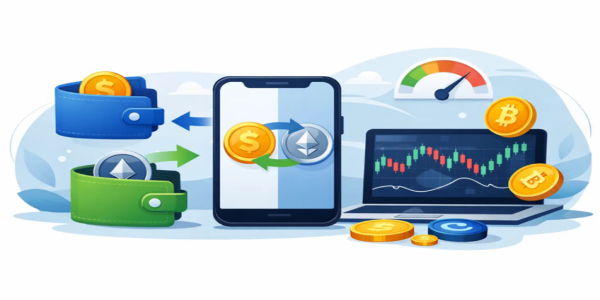
Wallet Swap Tools Review for Faster Crypto Trades
Our wallet swap tools review compares quotes, liquidity, custody, fees, and execution controls so you can exchange crypto with greater confidence with care.
A swap can look simple: choose the asset you hold, choose the asset you want, approve the transaction, and wait. But a wallet swap tools review quickly shows that the real difference between tools appears before you press confirm. A weak quote, thin liquidity route, hidden network cost, or careless approval can turn a fast exchange into an expensive mistake.
For traders who value direct market access, the right swap tool should reduce friction without asking you to trade away visibility or control. Speed matters. Privacy matters. So do transparent costs, reliable execution, and a wallet setup that lets you act when the market moves.
What Wallet Swap Tools Actually Do
Wallet swap tools let you exchange one crypto asset for another from a wallet interface or through a connected trading service. Instead of moving funds to a traditional exchange, waiting for deposits to clear, placing an order, and withdrawing again, you can request a conversion from the assets already under your control.
That convenience comes with a trade-off. A swap is not always a single market transaction. The tool may search multiple liquidity sources, use a liquidity pool, route through an intermediary asset, or rely on a third-party provider. The price shown on screen is only useful if you understand what it includes.
The best tools make the path clear: what you will receive, which network you are using, what fees apply, how much price movement is tolerated, and whether you keep custody until the transaction is authorized. If those answers are vague, convenience is doing too much work.
Wallet Swap Tools Review: The Five Checks That Matter
1. Start with the final amount, not the headline rate
A displayed exchange rate can be technically accurate and still tell you very little. What matters is the estimated amount arriving in your wallet after provider charges, network fees, routing costs, and price impact.
Compare the final receive amount across tools using the same asset pair and the same trade size. A tool advertising a low or zero swap fee may still produce a weaker final quote because of spread or routing. There is nothing wrong with paying for execution. The issue is paying without seeing it.
For small conversions, fixed network costs can dominate the trade. For larger swaps, liquidity depth and price impact usually matter more. The best option for a $75 conversion may not be the best option for a $7,500 position change.
2. Check liquidity before chasing a fast confirmation
Fast is valuable only when the trade executes close to the number you approved. Liquidity is what supports that outcome. Deep liquidity generally means less price impact, better routing choices, and fewer unpleasant surprises when trading a less common token.
Popular assets often have several available routes. Smaller-cap coins, newly launched tokens, and assets on less-used networks can be a different story. A wallet may offer the pair, but the route could be thin, indirect, or costly.
Look for a tool that shows price impact or warns when a route is unusually inefficient. If it does not, test with a small amount first. That is not hesitation. It is controlled execution.
3. Treat slippage settings as a trading decision
Slippage is the amount the price may move between your approval and execution. Set it too low and a transaction may fail during a volatile market. Set it too high and you give the transaction more room to execute at a price you did not intend.
There is no universal setting. Major, highly liquid assets may require tighter tolerance than volatile tokens. Network congestion and rapid market moves can also change the right approach. The key is to avoid leaving a broad default in place simply because it is convenient.
A quality swap interface explains the setting in plain language and lets you adjust it before confirming. That control is especially useful for traders moving quickly between assets during a market shift.
4. Know who holds the keys and who touches the route
Some swap tools work through a self-custody wallet, where you authorize transactions with your own wallet keys. Others involve hosted balances or outside liquidity providers. Each model can serve a purpose, but they do not offer the same level of control.
Self-custody can give you more direct authority over your funds. It also puts more responsibility on you to protect recovery information, verify transaction details, and avoid malicious token approvals. Hosted services may feel simpler, but you should understand their withdrawal rules, operational limits, and account requirements before moving meaningful funds.
Privacy-conscious users should also separate privacy from invisibility. Blockchain transactions can be publicly traceable, and different services may collect different levels of information. Review the tool's transaction flow and policies rather than relying on broad marketing language.
5. Review network support and bridge risk
A token name is not enough. USDC, ETH, and other well-known assets can exist on multiple networks. Sending or swapping the correct token on the wrong chain can create delays, extra fees, or recovery problems.
Cross-chain swaps add another layer. The tool may use a bridge to move value from one network to another, which means more contracts, more timing variables, and more points where an issue can occur. That does not make cross-chain trading a bad choice. It means the route deserves extra attention.
Before confirming, verify the sending network, receiving network, destination wallet, estimated arrival time, and whether the receiving wallet supports that exact asset version. A few seconds of verification can protect capital that took much longer to earn.
The Features Worth Paying Attention To
The strongest wallet swap tools are built for decisions, not just clicks. They show a clear quote breakdown, estimated network fees, minimum received amount, and transaction status. They let you reject a route that does not make sense instead of pushing you toward a single opaque option.
For active traders, execution flexibility matters too. Useful features include multiple quote sources, configurable slippage, saved wallet connections, transaction history, and support for the assets and networks you actually trade. If you move between crypto and dollar-based value regularly, access to reliable conversion options can reduce unnecessary transfers and missed opportunities.
Platforms such as Budrigan Market can appeal to users seeking fast access to a broad range of crypto trading and conversion choices. Still, the same standard applies everywhere: check the final quote, know the custody model, and confirm the network before authorizing any transaction.
Common Mistakes That Cost More Than Fees
The most expensive swap mistakes are usually avoidable. Traders rush because a chart is moving, approve an unfamiliar token permission, or assume a wallet label guarantees the correct network. Others compare only the exchange rate and ignore the final receive amount.
Avoid signing transactions you do not understand. Be cautious with token approvals, especially unlimited approvals that grant a smart contract broad access to a token balance. Use the official app or wallet interface, inspect the receiving address, and consider a small test transaction when using a new route or network.
Also remember that a completed blockchain transaction is generally difficult to reverse. The goal is not to make every trade slow. The goal is to build a quick pre-trade habit that catches errors before they become permanent.
When a Swap Tool Is Not the Best Option
Wallet swaps are excellent for direct conversions, quick portfolio adjustments, and users who prefer wallet-based control. They may be less attractive when you need advanced order types, highly specific entry prices, deep order-book visibility, or a large transaction that needs careful execution.
For those situations, a spot trading venue may offer more control over limit prices and order timing. The better route depends on the trade, not on loyalty to one interface. Freedom in crypto means having options and knowing when to use each one.
A Better Way to Make Your Next Swap
Before every swap, pause long enough to compare the final receive amount, verify the network, inspect slippage, and confirm what you are authorizing. Then use a tool whose controls match your trading style instead of accepting whatever route appears first. That small discipline keeps speed on your side and puts more of every trade under your control.
Share This Post
Recent Posts
-
Stablecoin Regulation Trends 2026 Explained
08 Oct 2026
-
Market Orders Versus Swaps: Know Your Trade
08 Oct 2026
-
Stablecoins Versus Bank Deposits Compared
08 Oct 2026
-
Crypto Taxes: Trade Freely, Report Clearly
08 Oct 2026
-
9 Top Wallet Security Mistakes to Stop Now
08 Oct 2026